Ace - AI Tutor
Ask Our Educators
Textbooks
My Library
Flashcards
Scribe - AI Notes
Notes & Exams
Download App
gregory mccormick

gregory m.

Divider

Questions asked

BEST MATCH

What effect does higher temperature have on simple diffusion? Decreased lipid-solubility and slower diffusion. Higher kinetic energy and faster diffusion. Increased lipid-solubility and faster diffusion. Slower kinetic energy and slower diffusion.

View Answer
divider
BEST MATCH

As the economics analyst for the KAB Consulting Team, you are asked to use the data provided in the figure below for the nation of Nevets and answer the following questions. Disposable income (billions of 2012 dollars) Consumption Expenditure (billions of 2012 dollars) 0 85 100 160 200 235 300 310 400 385 500 460 1. Calculate the marginal propensity to save 2. At what levels of income are there dis-savings?

View Answer
divider
BEST MATCH

As long as a firm’s choice of securities (debt vs equity) does not change the cash flows generated by its assets, the capital structure decision will not change the total value of the firm or the amount of capital it can raise.

View Answer
divider
BEST MATCH

Which of the following payments are taxable payments for federal unemployment tax? Group of answer choices Christmas gifts, excluding noncash gifts of nominal value Courtesy discounts to employees and their families Value of meals and lodging furnished employees for the convenience of the employer Workers' compensation payments Caddy fees

View Answer
divider
BEST MATCH

Question 34 True or False: The median of the values 3.4, 4.7, 1.9, 7.6, and 6.5 is 1.9. True False 2 pts

View Answer
divider
BEST MATCH

Which of the muscles below is found in the lower leg? extensor digitorum extensor digitorum longus

View Answer
divider
BEST MATCH

Costs Output 0 Figure A (1) (2) Input (3) (4) Figure B A Output Refer to the short-run production and cost data. The curves of Figures A and B suggest that

View Answer
divider
BEST MATCH

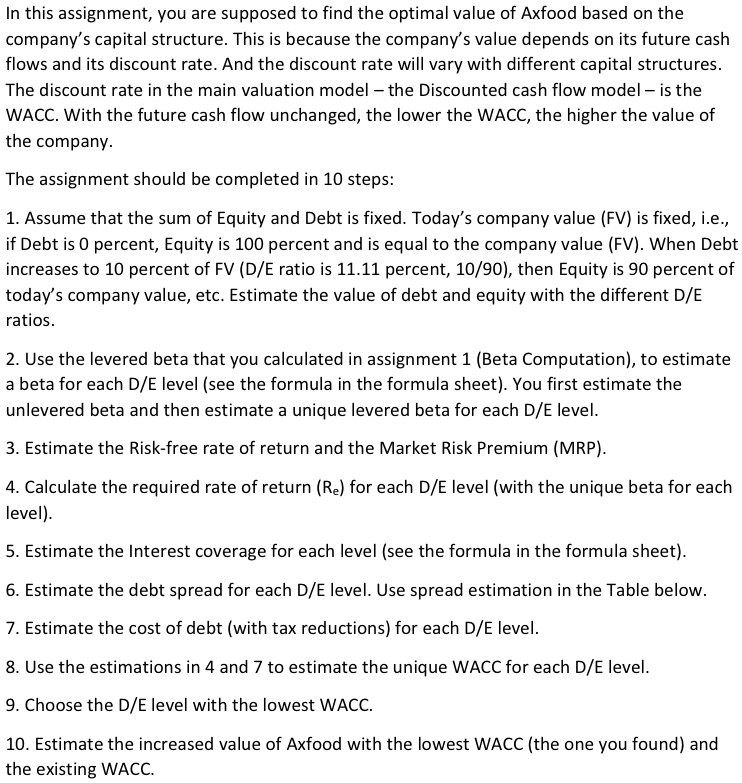
In this assignment, you are supposed to find the optimal value of Axfood based on the company's capital structure. This is because the company's value depends on its future cash flows and its discount rate. And the discount rate will vary with different capital structures. The discount rate in the main valuation model - the Discounted cash flow model - is the WACC. With the future cash flow unchanged, the lower the WACC, the higher the value of the company. The assignment should be completed in 10 steps: 1. Assume that the sum of Equity and Debt is fixed. Today's company value (FV) is fixed, i.e., if Debt is 0 percent, Equity is 100 percent and is equal to the company value (FV). When Debt increases to 10 percent of FV (D/E ratio is 11.11 percent, 10/90), then Equity is 90 percent of today's company value, etc. Estimate the value of debt and equity with the different D/E ratios. 2. Use the levered beta that you calculated in assignment 1 (Beta Computation), to estimate a beta for each D/E level (see the formula in the formula sheet). You first estimate the unlevered beta and then estimate a unique levered beta for each D/E level. 3. Estimate the Risk-free rate of return and the Market Risk Premium (MRP). 4. Calculate the required rate of return ($R_e$) for each D/E level (with the unique beta for each level). 5. Estimate the Interest coverage for each level (see the formula in the formula sheet). 6. Estimate the debt spread for each D/E level. Use spread estimation in the Table below. 7. Estimate the cost of debt (with tax reductions) for each D/E level. 8. Use the estimations in 4 and 7 to estimate the unique WACC for each D/E level. 9. Choose the D/E level with the lowest WACC. 10. Estimate the increased value of Axfood with the lowest WACC (the one you found) and the existing WACC.
View Answer
divider
BEST MATCH

2. \( g(x)=3 x^{2}+10 x-7 \) Show work: Form: y-intercept: zeros: Scale Factor:

View Answer
divider
BEST MATCH

lim X→C [f(x) - g(x)] ≤ lim X→C [f(x)] - lim X→C [g(x)] Therefore, lim X→C [f(x) - g(x)] ≤ lim X→C [f(x)] - lim X→C [g(x)] lim [f(x)g(x)] = lim [f(x)] * lim [g(x)] lim [f(x)g(x)] = lim [f(x)] * lim [g(x)] lim [(x)(x)] = 50 lim [(x)(x)] = 50

View Answer
divider