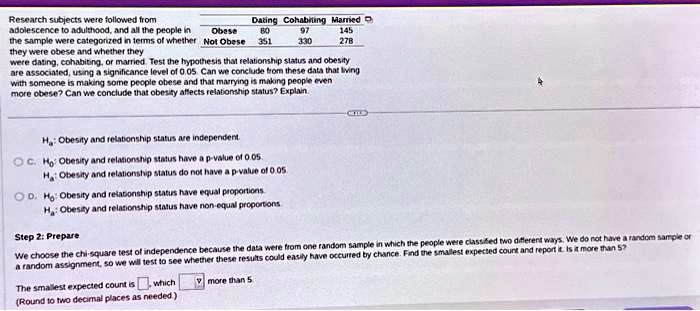
Research subjects were followed from
adolescence to adulthood, and all the people in
the sample were categorized in terms of whether
they were obese and whether they
were dating, cohabiting, or married. Test the hypothesis that relationship status and obesity
are associated, using a significance level of 0.05. Can we conclude from these data that living
with someone is making some people obese and that marrying is making people even
more obese? Can we conclude that obesity affects relationship status? Explain.
Ha: Obesity and relationship status are independent.
C. $H_0$: Obesity and relationship status have a p-value of 0.05.
$H_a$: Obesity and relationship status do not have a p-value of 0.05
D. $H_0$: Obesity and relationship status have equal proportions
$H_a$: Obesity and relationship status have non-equal proportions
Step 2: Prepare
We choose the chi-square test of independence because the data were from one random sample in which the people were classified two different ways. We do not have a random sample or
a random assignment, so we will test to see whether these results could easily have occurred by chance. Find the smallest expected count and report it. Is it more than 5?
The smallest expected count is , which more than 5.
(Round to two decimal places as needed.)