Ace - AI Tutor
Ask Our Educators
Textbooks
My Library
Flashcards
Scribe - AI Notes
Notes & Exams
Download App
gregory sureda

gregory s.

Divider

Questions asked

BEST MATCH

An image of a 2.0-cm object reflected from a mirror is 5.0 cm tall. What is the magnification of the mirror? ? 2.5 ? 0.40 ? 3.0 ? 10.0

View Answer
divider
BEST MATCH

Student who is transitioning to middle school has upper extremity contractures secondary to cerebral palsy. What should the OTR teach the classroom staff as part of the INITIAL intervention for managing this issue?

View Answer
divider
BEST MATCH

Question 8 of 13 Divide the following fractions and express the answer reduced to lowest terms. $\frac{5}{4} \div \frac{12}{7} = $

View Answer
divider
BEST MATCH

Use the properties of limits to help decide whether the limit exists. If the limit exists, find its value.\\ $\lim_{x \to \infty} \frac{4x}{6x - 9}$ \\ Select the correct choice below and, if necessary, fill in the answer box within your choice.\\ A. $\lim_{x \to \infty} \frac{4x}{6x - 9} = $ \\ (Simplify your answer. Type an integer or a fraction.)\\B. The limit does not exist and is neither $\infty$ nor $-\infty$.

View Answer
divider
BEST MATCH

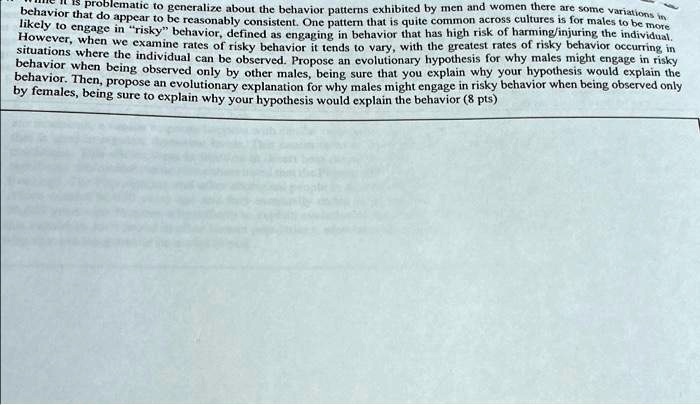
Is problematic to generalize about the behavior patterns exhibited by men and women there are some variations in behavior that do appear to be reasonably consistent. One pattern that is quite common across cultures is for males to be more likely to engage in "risky" behavior, defined as engaging in behavior that has high risk of harming/injuring the individual. However, when we examine rates of risky behavior it tends to vary, with the greatest rates of risky behavior occurring in situations where the individual can be observed. Propose an evolutionary hypothesis for why males might engage in risky behavior when being observed only by other males, being sure that you explain why your hypothesis would explain the behavior. Then, propose an evolutionary explanation for why males might engage in risky behavior when being observed only by females, being sure to explain why your hypothesis would explain the behavior (8 pts)
View Answer
divider
BEST MATCH

1. Suppose an agent's marginal cost function V'(E) is given by V'(E) = E/2, their production function is Q = 3E and their contract is given by Y = 15 + 0.2Q a. What is their marginal benefit? b. What effort level maximizes their utility? c. If the commission rate is increased to 0.5, does the effort level that maximizes their utility change? d. If the fixed pay is increased to 20, does the agent's effort level change?

View Answer
divider
BEST MATCH

30. a. Describe how structural effects and reaction conditions may influence the acidity of various alcohols. b. Describe, how the molecularity of a reaction step may be determined by experimental methods. (Answer question 5, if you did not earn full 10 bonus points of homework. If you earned 5 bonus points, they will be added to your account after answering).

View Answer
divider
BEST MATCH

Product Costs Production 31:22 Distribution 50% of Production Costs Question Adjust the pie chart to represent the product costs. Marketing 30% of Production Costs Sales Commissions 20% of Production Costs 25% 25% 25% 25% Next

View Answer
divider
BEST MATCH

Let's Gather Our Data: Forced Residual Capacity (FRC) Drag & Drop: Label this chart with the variable that we have measured & calculated so far. We will use these volumes to help us derive equations. EC FRC RV IRV ERV Volume (mL) • Volume of air remaining in the lungs after a normal, passive exhalation. • Calculate the FRC. • Use the labeled chart to help you figure out how to calculate FRC using the information that we already know. • FRC = ____ + _____ • The FRC is ____ mL. • FRC = ____ - ____ + _____ • The FRC is ____ mL. Time (seconds)

View Answer
divider
BEST MATCH

Problem 2 Consider a long rod immersed in a fluid per the schematic below: a) find the temperature Tint @ x=0 b) find the heat flux from the fluid to the upper rod c) plot the temperature distribution along the rod. x>0 x<0 T_{int} D=1 cm h_u=10 W/m$^2$K T_{\infty,u}=20$^\circ$C k=50 W/mK h_l=100 W/m$^2$K T_{\infty,l} = 40$^\circ$C

View Answer
divider