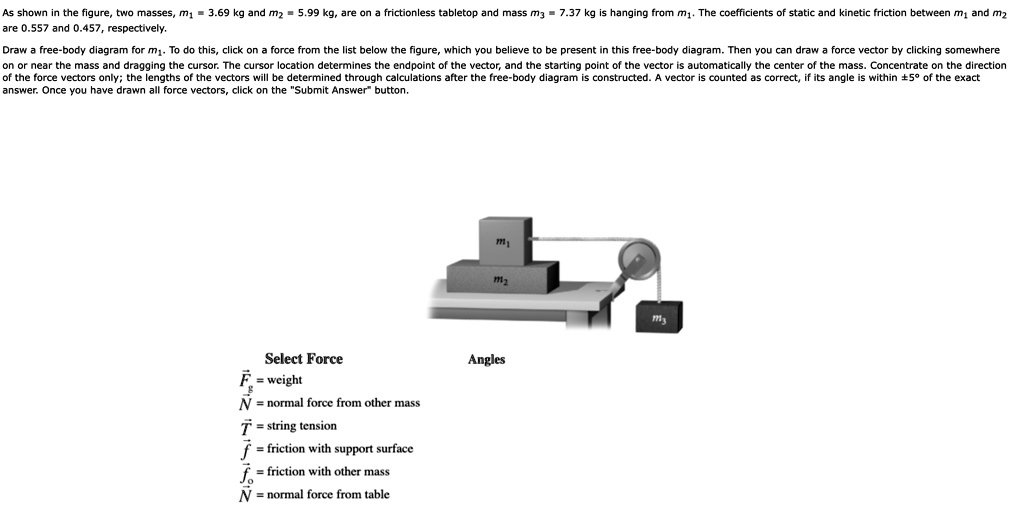
As shown in the figure, two masses, m1 = 3.69 kg and m2 = 5.99 kg, are on a frictionless tabletop and mass m3 = 7.37 kg is hanging from m1. The coefficients of static and kinetic friction between m1 and m2 are 0.557 and 0.457, respectively.
Draw a free-body diagram for m1. To do this, click on a force from the list below the figure, which you believe to be present in this free-body diagram. Then you can draw a force vector by clicking somewhere on or near the mass and dragging the cursor. The cursor location determines the endpoint of the vector, and the starting point of the vector is automatically the center of the mass. Concentrate on the direction of the force vectors only; the lengths of the vectors will be determined through calculations after the free-body diagram is constructed. A vector is counted as correct, if its angle is within pm 5deg of the exact answer. Once you have drawn all force vectors, click on the "Submit Answer" button.are 0.557 and 0.457 , respectively.
answer. Once you have drawn all force vectors, click on the "Submit Answer" button.
As shown in the figure, two masses, m = 3.69 kg and m = 5.99 kg, are on a frictionless tabletop and mass m3 = 7.37 kg is hanging from m. The coefficients of static and kinetic friction between m and m2 are 0.557 and 0.457,respectively.
Draw a free-body diagram for m. To do this, click on a force from the list below the figure, which you believe to be present in this free-body diagram. Then you can draw a force vector by clicking somewhere on or near the mass and dragging the cursor. The cursor location determines the endpoint of the vector, and the starting point of the vector is automatically the center of the mass. Concentrate on the direction of the force vectors only; the lengths of the vectors will be determined through calculations after the free-body diagram is constructed. A vector is counted as correct, if its angle is within 5 of the exact answer. Once you have drawn all force vectors, click on the "Submit Answer button.
Select Force F=weight = normal force from other mass T = string tension f=friction with support surface = friction with other mass Jo N = normal force from table
Angles