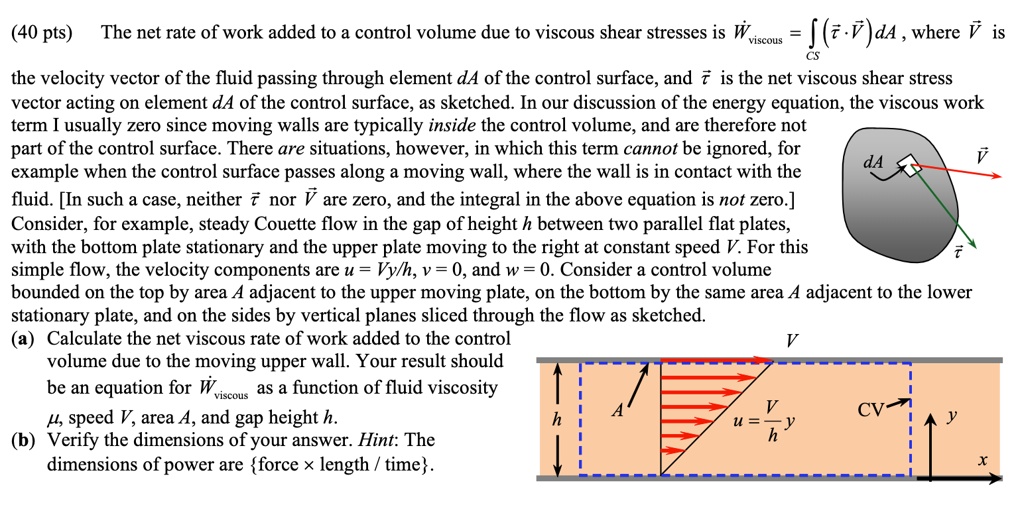
(40 pts) The net rate of work added to a control volume due to viscous shear stresses is \(\dot{W}_{viscous} = \int_{CS} (\vec{\tau} \cdot \vec{V}) dA\), where \(\vec{V}\) is the velocity vector of the fluid passing through element \(dA\) of the control surface, and \(\vec{\tau}\) is the net viscous shear stress vector acting on element \(dA\) of the control surface, as sketched. In our discussion of the energy equation, the viscous work term I usually zero since moving walls are typically inside the control volume, and are therefore not part of the control surface. There are situations, however, in which this term cannot be ignored, for example when the control surface passes along a moving wall, where the wall is in contact with the fluid. [In such a case, neither \(\vec{\tau}\) nor \(\vec{V}\) are zero, and the integral in the above equation is not zero.] Consider, for example, steady Couette flow in the gap of height \(h\) between two parallel flat plates, with the bottom plate stationary and the upper plate moving to the right at constant speed \(V\). For this simple flow, the velocity components are \(u = Vy/h\), \(v = 0\), and \(w = 0\). Consider a control volume bounded on the top by area \(A\) adjacent to the upper moving plate, on the bottom by the same area \(A\) adjacent to the lower stationary plate, and on the sides by vertical planes sliced through the flow as sketched.
(a) Calculate the net viscous rate of work added to the control volume due to the moving upper wall. Your result should be an equation for \(\dot{W}_{viscous}\) as a function of fluid viscosity \(\mu\), speed \(V\), area \(A\), and gap height \(h\).
(b) Verify the dimensions of your answer. Hint: The dimensions of power are \{force \times length / time\}.