Questions asked
A 35-year-old woman is admitted to the hospital with symptoms of intermittent blurred vision, weakness and loss of sensation in her legs. She has been complaining of pain and difficulty walking. She has also been experiencing cognitive issue related to thinking and problem solving recently. Neurological examination of brain and spinal cord using magnetic resonance imaging (MRI) showed demyelinating lesions, and other ancillary tests showed demyelinating damage to the auditory and visual pathway. A lumbar puncture is performed with the following results: CSF Results: Appearance: Colorless, clear WBC count: 35 cells/ µl (90% lymphocytes) Glucose: 60 mg/dl (plasma 100 mg/dl) Protein: 60 mg/dl (serum protein: 8 g/dl) Albumin: 47 mg/dl (serum albumin: 6 g/dl) IgG globulin: 15.7 mg/dl (serum IgG: 2 g/dL) Electrophoresis: oligoclonal bands present
Refractory periods in neurons Relative refractory period, period when cell membrane is depolarized Absolute refractory period, period when cell membrane is hyperpolarized Relative refractory period, period when voltage gated na channels are either open or inactive Absolute refractory period, period when voltage gated na channels are either open or inactive
What are the characteristics that can make malware harder to detect and eliminate?
Why must the Cu(IO3)2 solution be saturated in this experiment? Determining the concentration of a saturated solution will also give us the molar solubility. Because copper(II) iodate is only slightly soluble in water. The titration will be inaccurate if any solid copper(II) iodate is present. If the copper(II) iodate solution is not saturated, too much thiosulfate solution will be needed to reach the endpoint of the titration. Copper(II) iodate will not dissociate in water if the solution isn't saturated.
8. What is the role of the prostate gland in males? A) Produce sperm B) Produce testosterone C) Produce semen D) Produce eggs 9. Which hormone is responsible for stimulating ovulation in females? A) Estrogen B) Progesterone
If \(\int x(2x^2 + 3)^6 dx = \frac{1}{4} \int u^6 du\), then \(u\) must be equal to Select one: a. \(2x^2 - 3\) b. \(x^2 + 3\) c. \(2x^2 + 3\) d. \(\frac{2x^2 + 3}{4}\) e. \(2x^2 + 12\) f. \(2x^2\)
Andy varies the amount of weight participants are asked to lift above their heads (5 lbs, 10lbs, 15lbs) and then measures their sense of self-efficacy. This study is an example of a multi-factorial design single-factor experiment 2 x 3 experimental design quasiexperimental design
Q1. Define the following: Energy Power Renewable energy Nonrenewable energy Greenhouse effect Homework 1 Q2. What are the most common types of renewable energy? Q3. Count three types of Nonrenewable energy. Q4. Calculate the Following conversions: 9 N.M = J 4 kwh = J 3 BTU = J 5 kwh = BTU 8.75 MJ = kwh Q5. Give five disadvantages and five advantages for renewable energy.
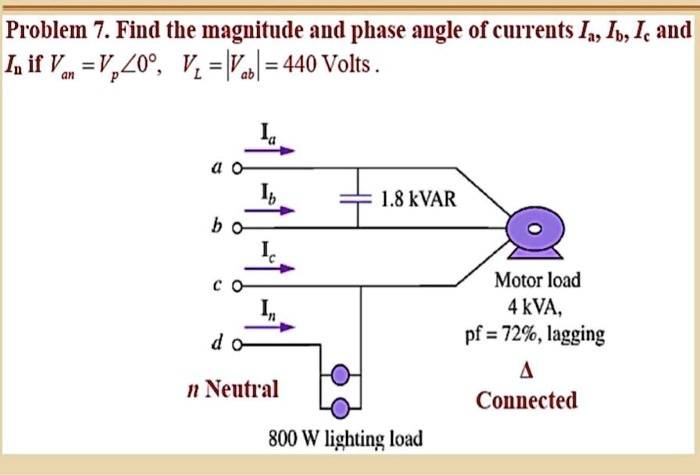
Problem 7. Find the magnitude and phase angle of currents I, Ib, Ic, and I if Van = V0 = V = 440 Volts. Ib = 1.8 kVAR Ic = CO Motor load = 4 kVA, pf = 72%, lagging In = do Neutral Connected 800 W lighting load
Question 2. Begin in a medium-run equilibrium where actual and expected inflation equals 2% in period 0 and suppose there is an increase in consumer confidence, e.g. due to a stock market boom, in period 1. Parts (a), (b) and (c) below assume adaptive expectations, i.e. $\pi^e_t = \pi_{t-1}$ (expected inflation in each period equals lagged inflation from the previous period). a. How does the IS curve change from period 0 to period 1? What is the value of expected inflation in period 0? How does the short-run equilibrium output and inflation rate in period 1 compare to the equilibrium output and inflation rate in period 0 if the central bank does not change the real policy rate from period to period 1? b. Now advance the economy to the period 2 equilibrium under the assumption that consumer confidence remains high. If the central bank leaves the real policy rate unchanged will inflation be higher or lower in period 2 than in period 1? c. What do you conclude about the central bank policy of keeping the real policy rate unchanged in period 2? Is it sustainable?