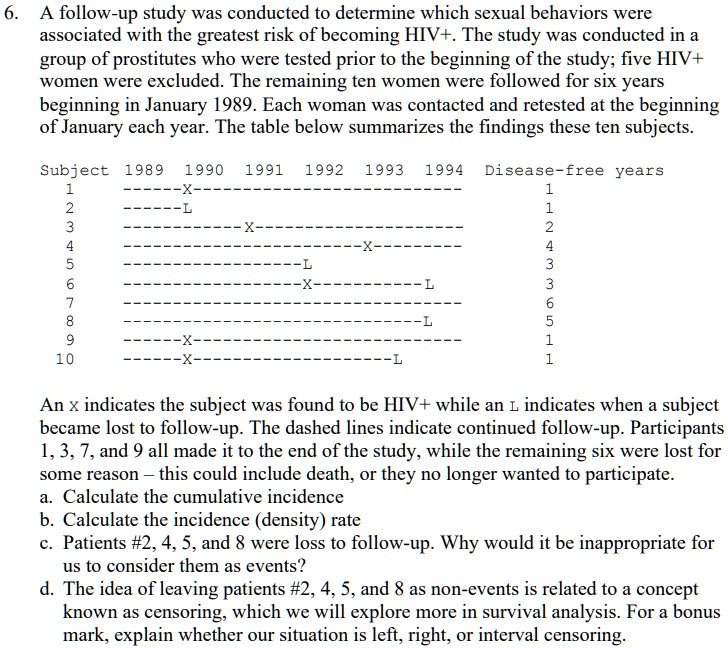
6. A follow-up study was conducted to determine which sexual behaviors were
associated with the greatest risk of becoming HIV+. The study was conducted in a
group of prostitutes who were tested prior to the beginning of the study; five HIV+
women were excluded. The remaining ten women were followed for six years
beginning in January 1989. Each woman was contacted and retested at the beginning
of January each year. The table below summarizes the findings these ten subjects.
Subject 1989 1990 1991 1992 1993 1994 Disease-free years
1
-X-
2
--L
3
4
5
6
7
8
9
X
10
---X-
X-
-X-
-L
X-
1
1
2
4
3
L
3
6
---L
5
1
L
1
An x indicates the subject was found to be HIV+ while an L indicates when a subject
became lost to follow-up. The dashed lines indicate continued follow-up. Participants
1, 3, 7, and 9 all made it to the end of the study, while the remaining six were lost for
some reason - this could include death, or they no longer wanted to participate.
a. Calculate the cumulative incidence
b. Calculate the incidence (density) rate
c. Patients #2, 4, 5, and 8 were loss to follow-up. Why would it be inappropriate for
us to consider them as events?
d. The idea of leaving patients #2, 4, 5, and 8 as non-events is related to a concept
known as censoring, which we will explore more in survival analysis. For a bonus
mark, explain whether our situation is left, right, or interval censoring.