Questions asked
Ronald Prasad
Numerade educator
Draw an arrow on the carbocation in the box on the left to show how it rearranges to the carbocation in the box on the right.
George Bennett
Of the three carbocations below, only one will readily undergo a hydride shift to form a more stable carbocation. Draw arrows on the carbocation that would undergo a hydride shift the fastest. Add the missing curved arrow notation.
In the boxes below, draw the mechanism arrows for each step of the SN1 reaction between an alkyl iodide and cyanide (?CN). Be sure to include lone pairs of electrons and nonzero formal charges on all species. Draw the mechanism arrows.
This carbocation rearranges. Draw the carbocation that is the result of the rearrangement. Include any nonzero formal charges in your drawing.
Jenny Wu
Rank the leaving groups below from worst to best. Question List (5 items) (Drag and drop into the appropriate area) -I -F -OH -Br -CH3 Correct Answer List Best Leaving Group 1 2 3
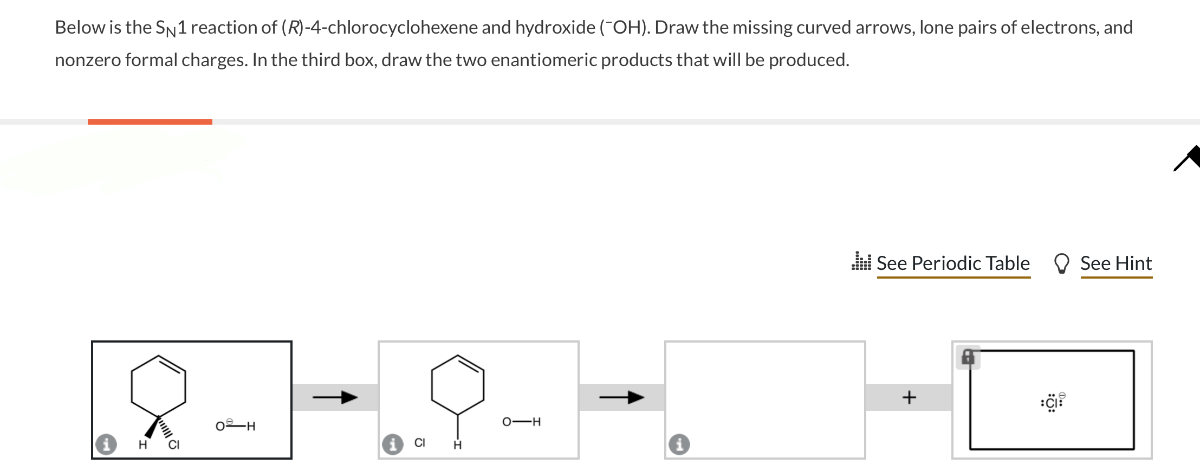
Below is the SN1 reaction of (R)-4-chlorocyclohexene and hydroxide (¯OH). Draw the missing curved arrows, lone pairs of electrons, and nonzero formal charges. In the third box, draw the two enantiomeric products that will be produced.
Draw the organic product for each of the below rearrangements. Be sure to include all nonzero formal charges. Rearrangement "A" Rearrangement "B"
Show the curved arrow mechanism and both products for the reaction between methyl iodide and ethoxide. Draw the organic product with all applicable lone pair electrons and non-zero formal charges.
This molecule undergoes a substitution reaction when stirred with water. In the box, draw all possible substitution products. Show the correct stereochemistry using wedges and dashes. Be sure to draw all bonds at the stereocenters. Draw only the organic product(s) and not inorganic side-products. Please draw all four bonds at chiral centers.
Draw the missing curved arrow notation for the rearrangement below. Add the missing curved arrow notation.