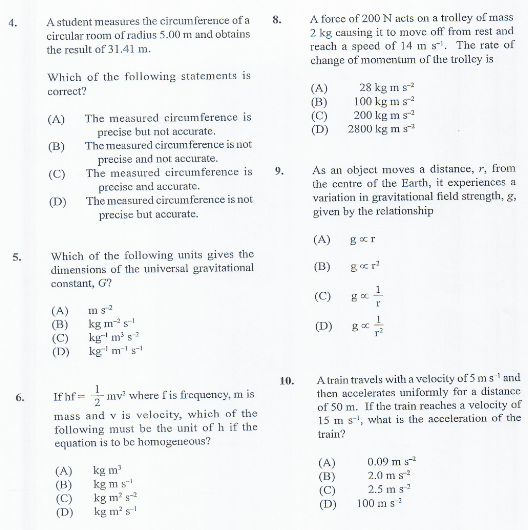
4. A student measures the circumference of a circular room of radius \( 5.00 \mathrm{~m} \) and obtains the result of \( 31.41 \mathrm{~m} \).
Which of the following statements is correct?
(A) The measured circumference is precise but not accurate.
(B) The measured circumference is not precise and not accurate.
(C) The measured circumference is precise and accurate.
(D) The measured circumference is not precise but accurate.
5. Which of the following units gives the dimensions of the universal gravitational constant, \( G \) ?
(A) \( \mathrm{m} \mathrm{s}^{-2} \)
(B) \( \mathrm{kg} \mathrm{m}^{-2} \mathrm{~s}^{-1} \)
(C) \( \mathrm{kg}^{-1} \mathrm{~m}^{3} \mathrm{~s}^{-2} \)
(D) \( \mathrm{kg}^{-1} \mathrm{~m}^{-1} \mathrm{~s}^{-1} \)
6. If hf \( =\frac{1}{2} m v^{2} \) where \( f \) is ficquency, \( m \) is mass and \( v \) is velocity, which of the following must be the unit of \( h \) if the equation is to be homogeneous?
(A) \( \quad \mathrm{kg} \mathrm{m} \mathrm{m}^{3} \)
(B) \( \quad \mathrm{kg} \mathrm{m} \mathrm{s} \mathrm{m}^{-1} \)
(C) \( \mathrm{kg} \mathrm{m} \mathrm{m}^{2} \mathrm{~s}^{-2} \)
(D) \( \quad \mathrm{kg} \mathrm{m}^{2} \mathrm{~s}^{-1} \)
8. A force of \( 200 \mathrm{~N} \) acts on a trolley of mass \( 2 \mathrm{~kg} \) causing it to move off from rest and reach a speed of \( 14 \mathrm{~m} \mathrm{~s} \mathrm{~s}^{-1} \). The rate of change of momentum of the trollcy is
(A) \( 28 \mathrm{~kg} \mathrm{~m} \mathrm{~s}^{-2} \)
(B) \( 100 \mathrm{~kg} \mathrm{~m} \mathrm{~s}^{-2} \)
(C) \( 200 \mathrm{~kg} \mathrm{~m} \mathrm{~s}^{-2} \)
(D) \( 2800 \mathrm{~kg} \mathrm{~m} \mathrm{~s}^{-1} \)
9. As an object moves a distance, \( r \), from the centre of the Earth, it experiences a variation in gravitational field strength, \( g \), given by the relationship
(A) \( \quad g \propto r \)
(B) \( \quad g \propto r^{2} \)
(C) \( \quad g \propto \frac{1}{r} \)
(D) \( \mathrm{g} \propto \frac{1}{\mathrm{r}^{2}} \)
10. A train travels with a velocity of \( 5 \mathrm{~m} \mathrm{~s}^{-1} \) and then accelerates uniformly for a distance of \( 50 \mathrm{~m} \). If the train reaches a velocity of \( 15 \mathrm{~m} \mathrm{~s}^{-1} \), what is the acceleration of the train?
(A) \( \quad 0.09 \mathrm{~m} \mathrm{~s}^{-2} \)
(B) \( \quad 2.0 \mathrm{~m} \mathrm{~s}^{-2} \)
(C) \( \quad 2.5 \mathrm{~m} \mathrm{~s}^{-2} \)
(D) \( 100 \mathrm{~ms}^{2} \)