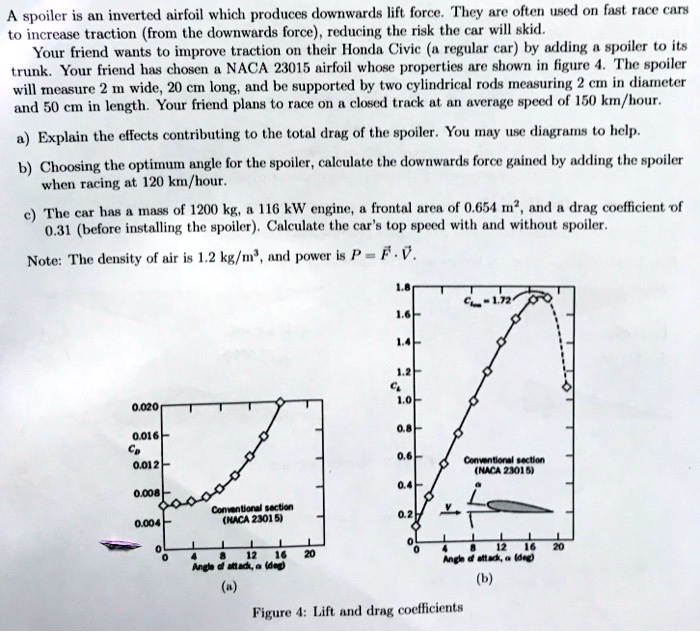
A spoiler is an inverted airfoil which produces downwards lift force. They are often used on fast race cars to increase traction (from the downwards force), reducing the risk the car will skid.
Your friend wants to improve traction on their Honda Civic (a regular car) by adding a spoiler to its trunk. Your friend has chosen a NACA 23015 airfoil whose properties are shown in figure 4. The spoiler will measure 2 m wide, 20 cm long, and be supported by two cylindrical rods measuring 2 cm in diameter and 50 cm in length. Your friend plans to race on a closed track at an average speed of 150 km/hour.
a) Explain the effects contributing to the total drag of the spoiler. You may use diagrams to help.
b) Choosing the optimum angle for the spoiler, calculate the downwards force gained by adding the spoiler when racing at 120 km/hour.
c) The car has a mass of 1200 kg, a 116 kW engine, a frontal area of 0.654 m², and a drag coefficient of 0.31 (before installing the spoiler). Calculate the car's top speed with and without spoiler.
Note: The density of air is 1.2 kg/m³, and power is $P = F \cdot V$.