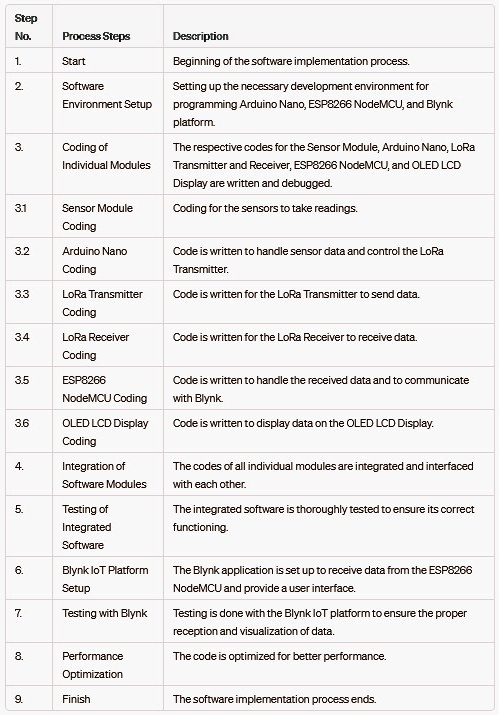
Step
No. Process Steps
Description
1.
Start
Beginning of the software implementation process.
2.
Software
Environment Setup
Setting up the necessary development environment for
programming Arduino Nano, ESP8266 NodeMCU, and Blynk
platform.
3.
Coding of
Individual Modules
The respective codes for the Sensor Module, Arduino Nano, LoRa
Transmitter and Receiver, ESP8266 NodeMCU, and OLED LCD
Display are written and debugged.
3.1
Sensor Module
Coding for the sensors to take readings.
Coding
3.2
Arduino Nano
Coding
Code is written to handle sensor data and control the LoRa
Transmitter.
3.3
LoRa Transmitter
Code is written for the LoRa Transmitter to send data.
Coding
3.4
LoRa Receiver
Code is written for the LoRa Receiver to receive data.
Coding
3.5
ESP8266
Code is written to handle the received data and to communicate
NodeMCU Coding
with Blynk.
3.6
OLED LCD Display
Code is written to display data on the OLED LCD Display.
Coding
4.
Integration of
Software Modules
The codes of all individual modules are integrated and interfaced
with each other.
5.
Testing of
The integrated software is thoroughly tested to ensure its correct
Integrated
functioning.
Software
6.
Blynk IoT Platform
Setup
The Blynk application is set up to receive data from the ESP8266
NodeMCU and provide a user interface.
7.
Testing with Blynk
Testing is done with the Blynk IoT platform to ensure the proper
reception and visualization of data.
8.
Performance
Optimization
The code is optimized for better performance.
9.
Finish
The software implementation process ends.