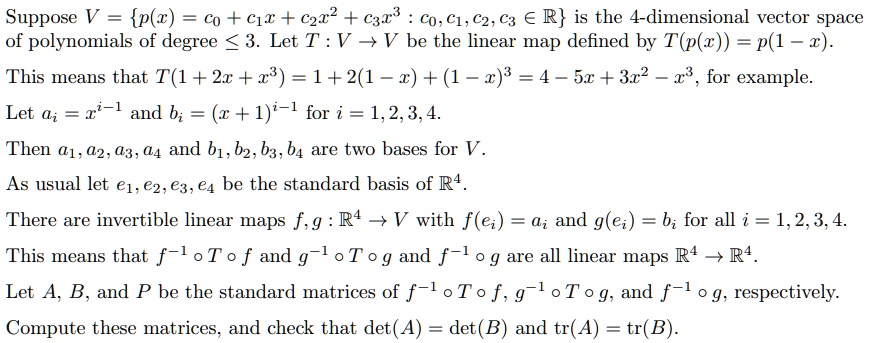
Suppose V = \{p(x) = c_0 + c_1x + c_2x^2 + c_3x^3: c_0, c_1, c_2, c_3 \in \mathbb{R}\} is the 4-dimensional vector space of polynomials of degree \le 3. Let T: V \to V be the linear map defined by T(p(x)) = p(1 - x).
This means that T(1 + 2x + x^3) = 1 + 2(1 - x) + (1 - x)^3 = 4 - 5x + 3x^2 - x^3, for example.
Let a_i = x^{i-1} and b_i = (x + 1)^{i-1} for i = 1, 2, 3, 4.
Then a_1, a_2, a_3, a_4 and b_1, b_2, b_3, b_4 are two bases for V.
As usual let e_1, e_2, e_3, e_4 be the standard basis of \mathbb{R}^4.
There are invertible linear maps f, g: \mathbb{R}^4 \to V with f(e_i) = a_i and g(e_i) = b_i for all i = 1, 2, 3, 4.
This means that f^{-1} \circ T \circ f and g^{-1} \circ T \circ g and f^{-1} \circ g are all linear maps \mathbb{R}^4 \to \mathbb{R}^4.
Let A, B, and P be the standard matrices of f^{-1} \circ T \circ f, g^{-1} \circ T \circ g, and f^{-1} \circ g, respectively.
Compute these matrices, and check that det(A) = det(B) and tr(A) = tr(B).