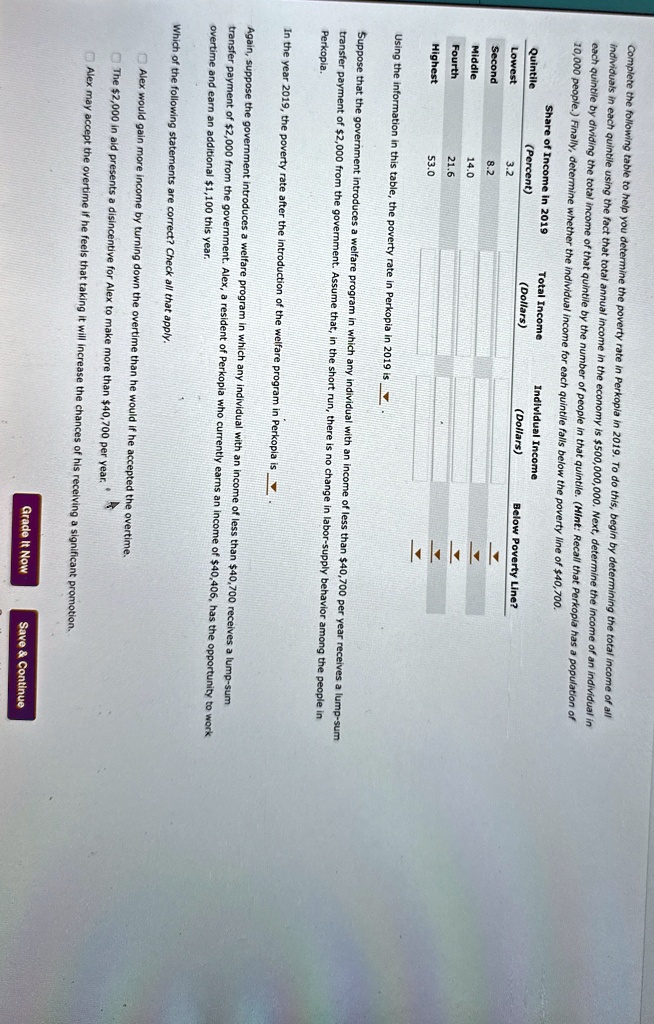
Complete the following table to help you determine the poverty rate in Perkopia in 2019. To do this, begin by determining the total income of all
individuals in each quintile using the fact that total annual income in the economy is $500,000,000. Next, determine the income of an individual in
each quintile by dividing the total income of that quintile by the number of people in that quintile. (Hint: Recall that Perkopia has a population of
10,000 people.) Finally, determine whether the individual income for each quintile falls below the poverty line of $40,700.
Share of Income in 2019
Quintile
(Percent)
Lowest
3.2
Second
8.2
Middle
14.0
Fourth
21.6
Highest
53.0
Total Income
(Dollars)
Individual Income
(Dollars)
Below Poverty Line?
✓
▼
Using the information in this table, the poverty rate in Perkopia in 2019 is
Suppose that the government introduces a welfare program in which any individual with an income of less than $40,700 per year receives a lump-sum
transfer payment of $2,000 from the government. Assume that, in the short run, there is no change in labor-supply behavior among the people in
Perkopia.
In the year 2019, the poverty rate after the introduction of the welfare program in Perkopia is▾
Again, suppose the government introduces a welfare program in which any individual with an income of less than $40,700 receives a lump-sum
transfer payment of $2,000 from the government. Alex, a resident of Perkopia who currently earns an income of $40,406, has the opportunity to work
overtime and earn an additional $1,100 this year.
Which of the following statements are correct? Check all that apply.
Alex would gain more income by turning down the overtime than he would if he accepted the overtime.
The $2,000 in aid presents a disincentive for Alex to make more than $40,700 per year.
A
Alex may accept the overtime if he feels that taking it will increase the chances of his receiving a significant promotion.
Grade It Now
Save & Continue