Question 7
33 pts
Suppose you have a company offering a subscription service and would like to identify what
drives customer loyalty. To that end, you collect data on a large set of customers and run a
logistic regression where the response is Loyal which equals 1 if the customer has stayed with
your company for more than a year and 0 otherwise. As predictors, you use Age, Income, and
Single. Here, Age is the age of the customer, Income is income in $1000s, and Single is a
binary that is 1 if the customer is on a single plan and 0 otherwise. Below you see a
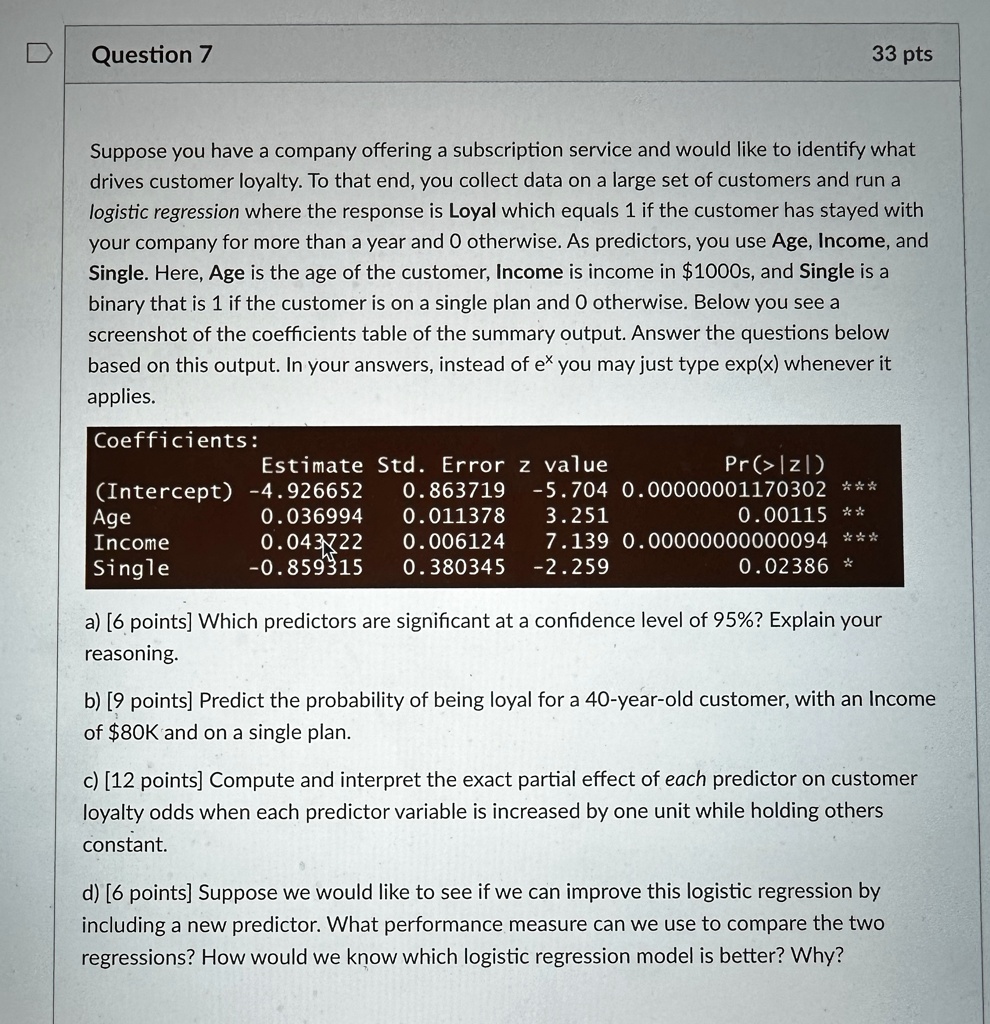
screenshot of the coefficients table of the summary output. Answer the questions below
based on this output. In your answers, instead of $e^x$ you may just type exp(x) whenever it
applies.
Coefficients:
Estimate Std. Error z value Pr(>|z|)
(Intercept) -4.926652 0.863719 -5.704 0.00000001170302 ***
Age 0.036994 0.011378 3.251 0.00115 **
Income 0.043222 0.006124 7.139 0.00000000000094 ***
Single -0.859315 0.380345 -2.259 0.02386 *
a) [6 points] Which predictors are significant at a confidence level of 95%? Explain your
reasoning.
b) [9 points] Predict the probability of being loyal for a 40-year-old customer, with an Income
of $80K and on a single plan.
c) [12 points] Compute and interpret the exact partial effect of each predictor on customer
loyalty odds when each predictor variable is increased by one unit while holding others
constant.
d) [6 points] Suppose we would like to see if we can improve this logistic regression by
including a new predictor. What performance measure can we use to compare the two
regressions? How would we know which logistic regression model is better? Why?