QBA 282 Chapter 4 Practice Questions
1. An experiment has three steps, with three outcomes possible for the first step, two outcomes possible for the second step, and four for the third step. How many outcomes exist for this experiment?
2. An experiment with three outcomes has been repeated 50 times. It was learned that E1 occurred 20 times, E2 occurred 13 times, and E3 occurred 17 times. Assign probabilities to the outcomes given.
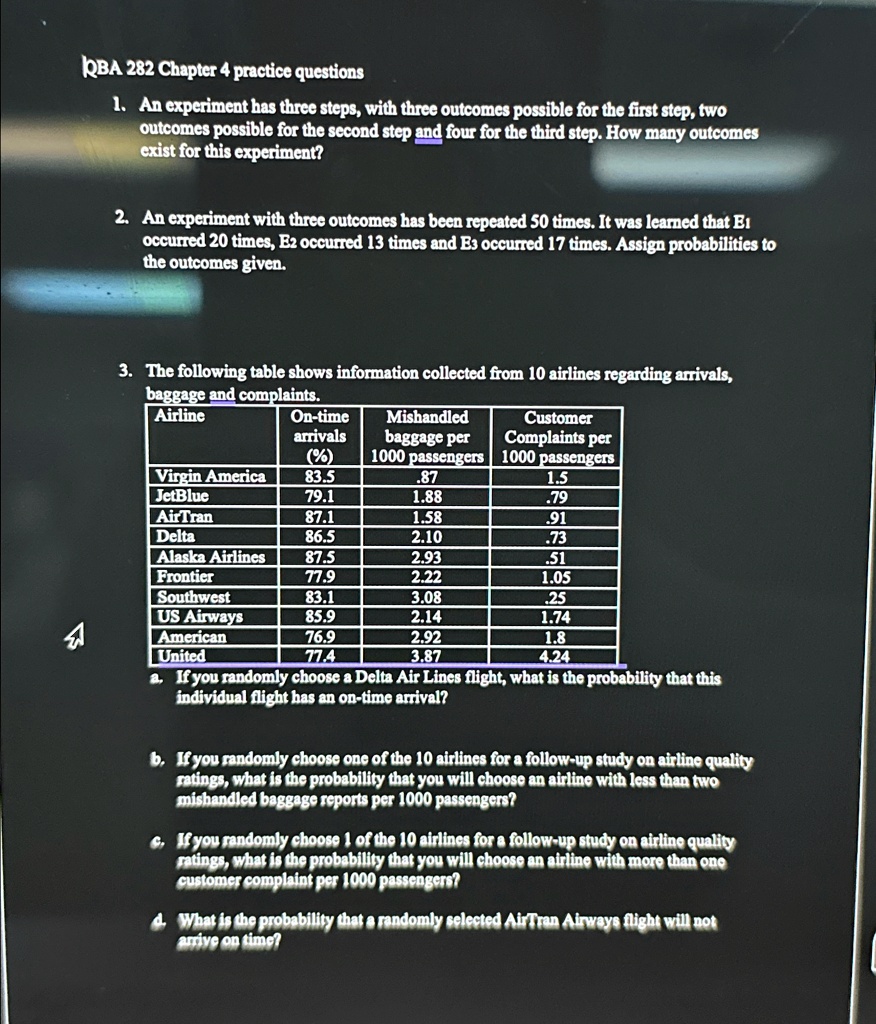
3. The following table shows information collected from 10 airlines regarding arrivals, baggage, and complaints.
| Airline | On-time (%) | Mishandled baggage per 1000 passengers | Customer Complaints per 1000 passengers |
|-----------------|-------------|---------------------------------------|-----------------------------------------|
| Virgin America | 83.5 | 0.87 | 1.5 |
| JetBlue | 79.1 | 1.88 | 0.79 |
| AirTran | 87.1 | 1.58 | 1.6 |
| Delta | 86.5 | 2.10 | 0.73 |
| Alaska Airlines | 87.5 | 2.93 | 0.51 |
| Frontier | 77.9 | 2.22 | 1.05 |
| Southwest | 83.1 | 3.08 | 0.25 |
| US Airways | 85.9 | 2.14 | 1.74 |
| American | 76.9 | 2.92 | 1.8 |
| United | 77.4 | 3.87 | 4.24 |
- If you randomly choose a Delta Air Lines flight, what is the probability that this individual flight has an on-time arrival?
- If you randomly choose one of the 10 airlines for a follow-up study on airline quality ratings, what is the probability that you will choose an airline with less than two mishandled baggage reports per 1000 passengers?
- If you randomly choose 1 of the 10 airlines for a follow-up study on airline quality ratings, what is the probability that you will choose an airline with more than one customer complaint per 1000 passengers?
- What is the probability that a randomly selected AirTran Airways flight will not arrive on time?