There are multiple errors in the provided text. Here are the corrected versions:
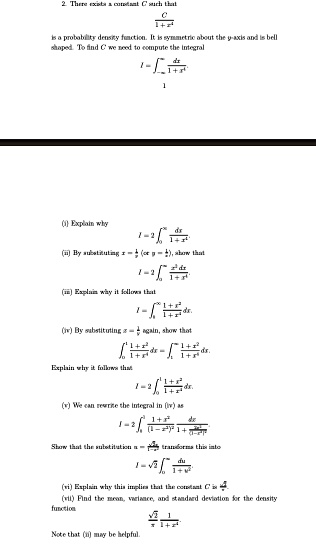
1. There exists a constant C such that
(C)/(1+x^(4))
is a probability density function. It is symmetric about the y-axis and is bell-shaped. To find C we need to compute the integral
I=int_{-infty}^{infty} (dx)/(1+x^(4)).
(i) Explain why
I=2int_{0}^{infty} (dx)/(1+x^(2)).
(ii) By substituting x=(1)/(y), show that
I=2int_{0}^{infty} (x^(2)dx)/(1+x^(4)).
(iii) Explain why it follows that
I=int_{1}^{infty} (1+x^(2))/(1+x^(2))dx.
(iv) By substituting x=(1)/(y) again, show that
int_{0}^{1} (1+x^(2))/(1+x^(4))dx=int_{1}^{infty} (1+x^(2))/(1+x^(4))dx.
Explain why it follows that
I=2int_{0}^{1} (1+x^(2))/(1+x^(2))dx.
(v) We can rewrite the integral in (iv) as
I=2int_{1}^{2} (1+x^(2))/((1-x^(2))^(2))(dx)/(1+(pi)/(d-Gamma |^(2))).
Show that the substitution n=(4)/(1-2) transforms this into
I=sqrt{2}int_{0}^{infty} (du)/(1+v^(2)).
(vi) Explain why this implies that the constant C is 4.
(vii) Find the mean, variance, and standard deviation for the density function
(sqrt{2})/(pi)(1)/(1+x^(4)).
Note that (ii) may be helpful.
2. There is a probability density function. It is symmetric about the y-axis and is bell-shaped. To find C we need to compute the integral as I= 1+.
(i) Explain why
1-21.
(ii) By substituting y = , show that 1-1.
(iii) Explain why it follows that 1-1.
(iv) By substituting g = again, show that
Explain why it follows that 1-2.
(v) We can rewrite the integral in (iv) as 1-2.
Show that the substitution M transforms this into 1-vi#.
(vii) Find the standard function.
Note that (ii) may be helpful.