Ace - AI Tutor
Ask Our Educators
Textbooks
My Library
Flashcards
Scribe - AI Notes
Notes & Exams
Download App
heather carr

heather c.

Divider

Questions asked

BEST MATCH

Example (min_(xinR)f(x)=(1+(2-x)^(2))/(1+x^(2))) Example ($\min_{x \in \mathbb{R}} f(x) = \frac{1+(2-x)^2}{1+x^2}$)

View Answer
divider
BEST MATCH

Select all fields that are part of the IP Header (IPv4): Header Checksum Port Number Fragment Offset TTL Source IP address

View Answer
divider
BEST MATCH

While assessing a neonate patient, the paramedics find it difficult to obtain a rectal temperature which of the following findings would indicate a high suspicion of fever, other than feeling warm to the touch

View Answer
divider
BEST MATCH

Cash received and paid is not the basis used to recognize revenues and expenses

View Answer
divider
BEST MATCH

What is the purpose of the os.chdir() function in Python? Question 61 options: It changes the current working directory to a specified path. It lists the contents of the current working directory. It checks if a directory exists in the given path. It creates a new directory at the specified path.

View Answer
divider
BEST MATCH

Please answer ALL the following parts that pertain to the same problem and please make sure they are correct: Experiments 1 and 2 : identical blocks on a level / frictionless surface. Each is pushed through the same distance, d 0 , by the same force, F 0 In exp 1 both blocks start and end at rest and in exp 2 both blocks start at rest and have a final speed of vf 2 . System 1 : Two blocks and spring in exp 1 . The spring has a constant k 1 and is initially neither stretched nor compressed. System 2 : Two blocks in exp 2 . Experiment 3 is similar to exp 1 , but the spring in exp 3 is weaker than in experiment 1 ( k 3 < k 1 ) . At the end of experiment 3 , each block has a speed of vf 3 . System 3 : Two blocks and spring in exp 3 . The spring has a constant k 3 and is initially neither stretched nor compressed.

View Answer
divider
BEST MATCH

The intersection of a firm's marginal revenue and marginal cost curves determines the level of output at which MC = min. ATC

View Answer
divider
BEST MATCH

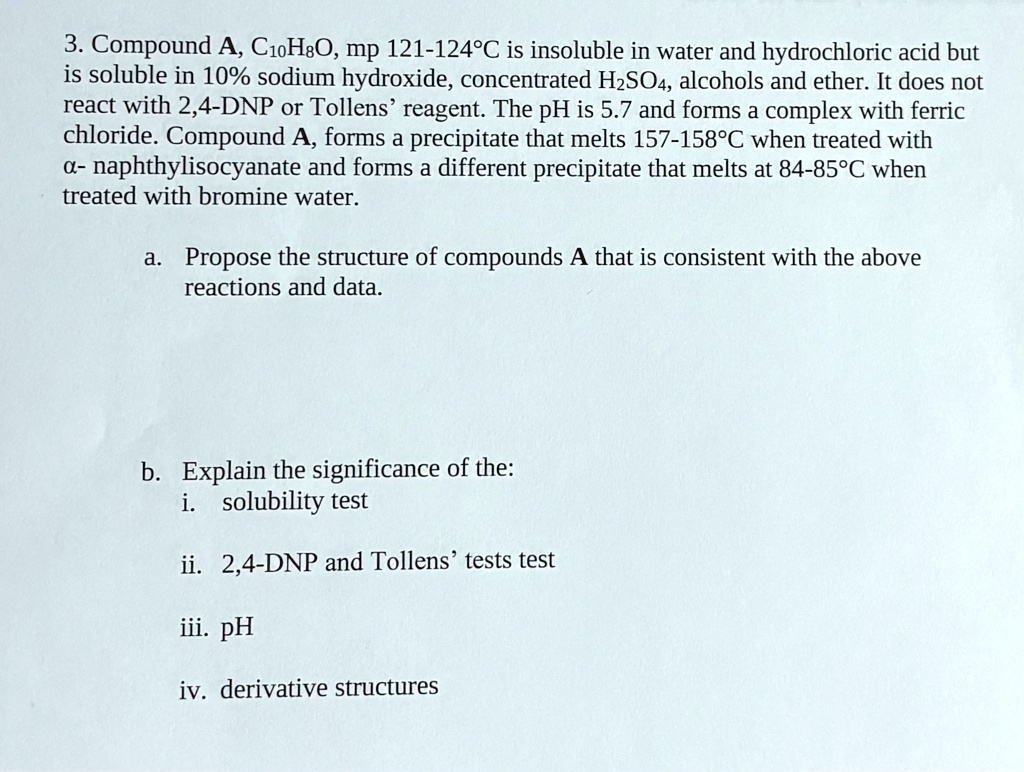
Compound A, C10H8O, mp 121-124°C, is insoluble in water and hydrochloric acid but is soluble in 10% sodium hydroxide, concentrated H2SO4, alcohols, and ether. It does not react with 2,4-DNP or Tollens' reagent. The pH is 5.7 and forms a complex with ferric chloride. Compound A forms a precipitate that melts at 157-158°C when treated with α-naphthylisocyanate and forms a different precipitate that melts at 84-85°C when treated with bromine water. a. Propose the structure of compound A that is consistent with the above reactions and data. b. Explain the significance of the: i. solubility test ii. 2,4-DNP and Tollens' tests iii. pH iv. derivative structures Compound A, C10H8O, mp 121-124°C, is insoluble in water and hydrochloric acid but is soluble in 10% sodium hydroxide, concentrated H2SO4, alcohols, and ether. It does not react with 2,4-DNP or Tollens' reagent. The pH is 5.7 and forms a complex with ferric chloride. Compound A forms a precipitate that melts at 157-158°C when treated with α-naphthylisocyanate and forms a different precipitate that melts at 84-85°C when treated with bromine water. a. Propose the structure of compound A that is consistent with the above reactions and data. b. Explain the significance of the: i. solubility test ii. 2,4-DNP and Tollens' tests iii. pH iv. derivative structures
View Answer
divider
BEST MATCH

In terms of information systems a collaboration tool that helps the team communicate organize plan schedule track and delegate jobs be an example of

View Answer
divider
BEST MATCH

4. Your drawing in Question #2 should have electric field lines connecting the positive charges at $\rho = a$ to the negative charges at $\rho = b$. Use Gauss' Law to determine the electric field in that region. You should draw your Gaussian surface on the diagram attached to Question #1. Calculating the Capacitance of a Cylindrical Capacitor Tutorial, University of Arizona Contact: (Drew) milsoms@email.arizona.edu 2 Calculating the Capacitance of a Cylindrical Capacitor We are now ready to calculate the capacitance of this system using the definition of capacitance $C = \frac{Q}{\Delta V}$. Since the cylinders are infinitely long, the capacitance will also be infinite so what we will actually calculate is the capacitance for a finite length $L$. While solving Question #3, you already determined that the charge in a length $L$ is $\lambda L$ so we only need to calculate the denominator. 5. Determine the electric potential difference between the capacitor \"plates\" using the expression $\Delta V = - \int \vec{E} \cdot d\vec{s}$. 6. Use the result of Question #5 to determine the capacitance per unit length. Verify that your expression has the correct units.

View Answer
divider