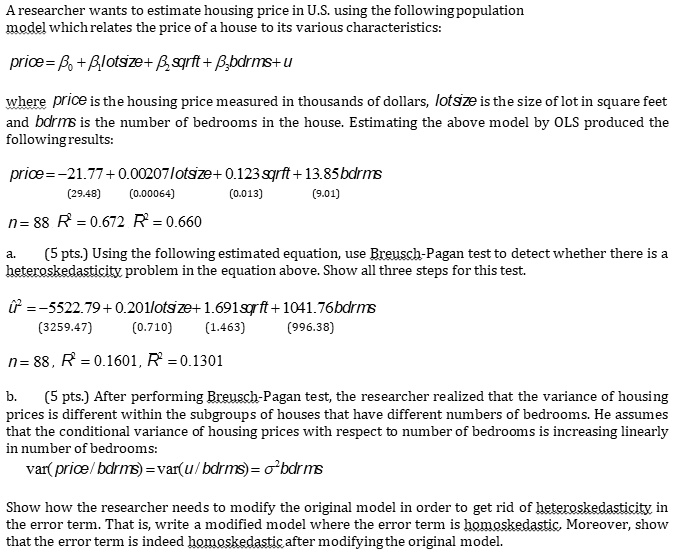
A researcher wants to estimate housing prices in the U.S. using the following population model which relates the price of a house to its various characteristics:
price = β0 + β1 * lotsize + β2 * sqrft + β3 * bdrms + u
where price is the housing price measured in thousands of dollars, lotsize is the size of the lot in square feet, and bdrms is the number of bedrooms in the house. Estimating the above model by OLS produced the following results:
price = -21.77 + 0.00207 * lotsize + 0.123 * sqrft + 13.85 * bdrms (29.48) (0.00064) (0.013) (9.01)
n = 88, R^2 = 0.672, R^2 = 0.660
a. (5 pts.) Using the following estimated equation, use the Breusch-Pagan test to detect whether there is a heteroskedasticity problem in the equation above. Show all three steps for this test.
price = -5522.79 + 0.201 * lotsize + 1.691 * sqrft + 1041.76 * bdrms (3259.47) 0.710 (1.463) (996.38)
n = 88, R^2 = 0.1601, R^2 = 0.1301
b. (5 pts.) After performing the Breusch-Pagan test, the researcher realized that the variance of housing prices is different within the subgroups of houses that have different numbers of bedrooms. He assumes that the conditional variance of housing prices with respect to the number of bedrooms is increasing linearly in the number of bedrooms: var(price|bdrms) = σ^2(bdrms) = σ^2 * bdrms
Show how the researcher needs to modify the original model in order to get rid of heteroskedasticity in the error term. That is, write a modified model where the error term is homoskedastic. Moreover, show that the error term is indeed homoskedastic after modifying the original model.