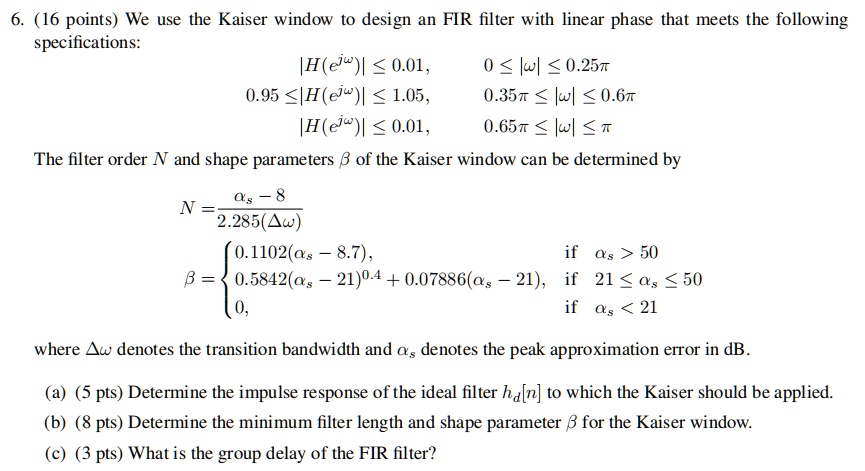
6. (16 points) We use the Kaiser window to design an FIR filter with linear phase that meets the following specifications:
$|H(e^{j\omega})| \le 0.01$, $0 \le |\omega| \le 0.25\pi$
$0.95 \le |H(e^{j\omega})| \le 1.05$, $0.35\pi \le |\omega| \le 0.6\pi$
$|H(e^{j\omega})| \le 0.01$, $0.65\pi \le |\omega| \le \pi$
The filter order $N$ and shape parameters $\beta$ of the Kaiser window can be determined by
$N = \frac{\alpha_s - 8}{2.285(\Delta\omega)}$
$\beta = \begin{cases} 0.1102(\alpha_s - 8.7), & \text{if } \alpha_s > 50 \\ 0.5842(\alpha_s - 21)^{0.4} + 0.07886(\alpha_s - 21), & \text{if } 21 \le \alpha_s \le 50 \\ 0, & \text{if } \alpha_s < 21 \end{cases}$
where $\Delta\omega$ denotes the transition bandwidth and $\alpha_s$ denotes the peak approximation error in dB.
(a) (5 pts) Determine the impulse response of the ideal filter $h_d[n]$ to which the Kaiser should be applied.
(b) (8 pts) Determine the minimum filter length and shape parameter $\beta$ for the Kaiser window.
(c) (3 pts) What is the group delay of the FIR filter?