Questions asked
Anjali Kurse
Numerade educator
Conceptual Problem 8.21 Part A Is the reaction represented in the drawing likely to have a positive or a negative value of ?S°? positive negative Figure 1 of 1 Reaction
Tianyu Li
Use the information in the table to calculate Δ H∘ in kilojoules for the photosynthesis of glucose (C6H12O6) and O2 from CO2 and liquid H2O , a reaction carried out by all green plants. TABLE Standard Heats of Formation for Some Common Substances at 25 ∘C Substance Formula Δ H∘f (kJ/mol) Substance Formula Δ H∘f (kJ/mol) Acetylene C2H2(g) 227.4 Hydrogen chloride HCl(g) -92.3 Ammonia NH3(g) -46.1 Iron (III) oxide Fe2O3(s) -824.2 Carbon dioxide CO2(g) -393.5 Magnesium carbonate MgCO3(s) -1095.8 Carbon monoxide CO(g) -110.5 Methane CH4(g) -74.8 Ethanol C2H5OH(l) -277.7 Nitric oxide NO(g) 91.3 Ethylene C2H4(g) 52.3 Water (g) H2O(g) -241.8 Glucose C6H12O6(s) -1273.3 Water (l) H2O(l) -285.8 Express your answer using four significant figures. ΔH∘ = kJ
For the reaction I2(g) → I2(s), ΔH° = -62.4 kJ at 25°C. Based on these data, at 25°C ΔH°sub = 62.4 kJ/mol. ΔH°vap = -62.4 kJ/mol. ΔH°sub = -62.4 kJ/mol. ΔH°vap = 62.4 kJ/mol.
Preeti Kumari
Chapter 8 Multiple Choice Question 26 Part A For the reaction I2(g) ? I2(s), ?H' = -62.4 kJ at 25°C. Based on these data, at 25°C ?H'sub = 62.4 kJ/mol. ?H'vap = -62.4 kJ/mol. ?H'sub = -62.4 kJ/mol. ?H'vap = 62.4 kJ/mol.
Part C Consider the exothermic reaction C3H8(g) + 10O2(g) -> 3CO2(g) + 4H2O(g) Calculate the standard heat of reaction, or ?H°rxn, for this reaction using the given data. Also consider that the standard enthalpy of the formation of elements in their pure form is considered to be zero. Reactant or product | ?H°f (kJ/mol) C3H8(g) | -104 CO2(g) | -393.5 H2O(g) | -241.8 Express your answer to four significant figures and include the appropriate units.
Problem 8.16 Use the information in the table to calculate ? H° in kilojoules for the photosynthesis of glucose (C6H12O6) and O2 from CO2 and liquid H2O, a reaction carried out by all green plants. TABLE Standard Heats of Formation for Some Common Substances at 25 °C Substance | Formula | ? H°f (kJ/mol) | Substance | Formula | ? H°f (kJ/mol) Acetylene | C2H2(g) | 227.4 | Hydrogen chloride | HCl(g) | -92.3 Ammonia | NH3(g) | -46.1 | Iron(III) oxide | Fe2O3(s) | -824.2 Carbon dioxide | CO2(g) | -393.5 | Magnesium carbonate | MgCO3(s) | -1095.8 Carbon monoxide | CO(g) | -110.5 | Methane | CH4(g) | -74.8 Ethanol | C2H5OH(l) | -277.7 | Nitric oxide | NO(g) | 91.3 Ethylene | C2H4(g) | 52.3 | Water (g) | H2O(g) | -241.8 Glucose | C6H12O6(s) | -1273.3 | Water (l) | H2O(l) | -285.8 Express your answer using four significant figures. ?H° = [ ] kJ
Lijeesh Krishnan
At a given temperature and pressure, which of the following would be expected to have the greatest molar entropy? Cl2(g) Cl2(l) Cl2(s) All of these would be expected to have the same molar entropy.
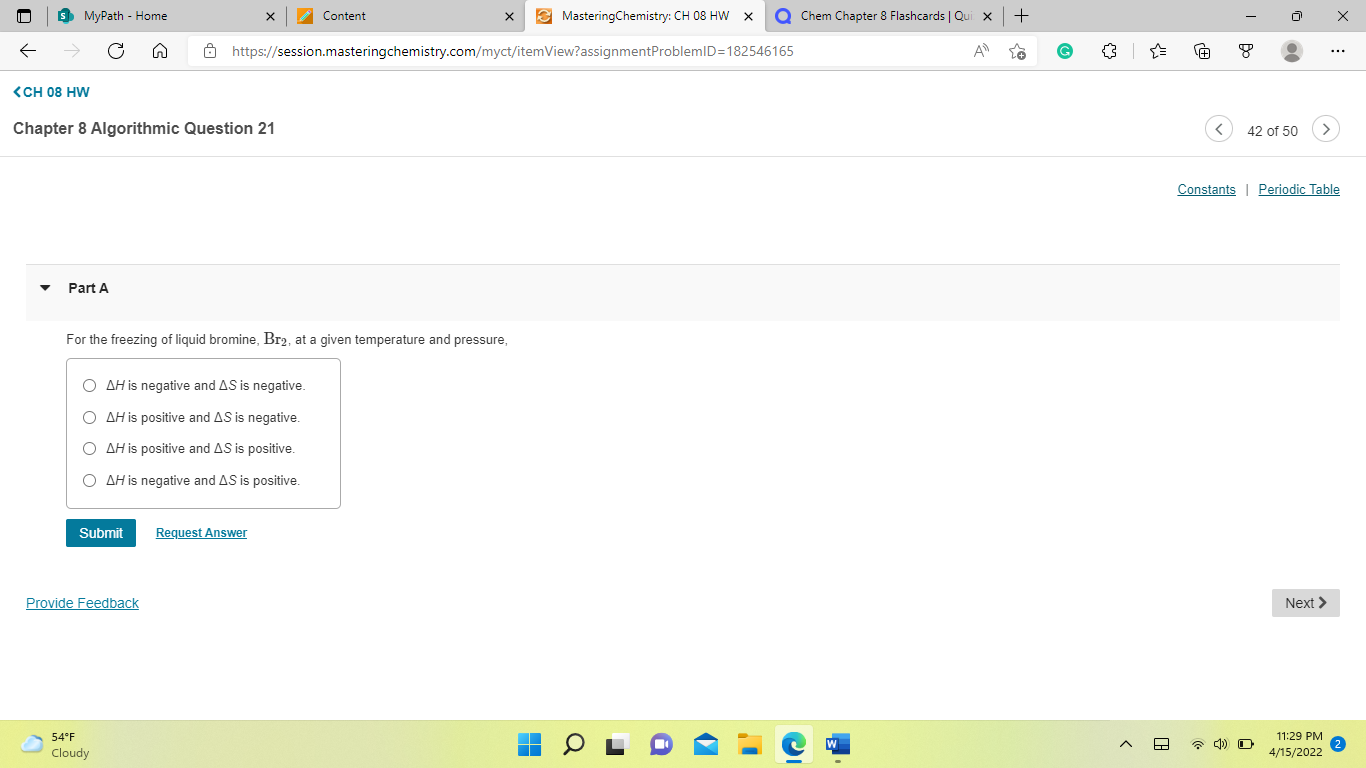
Part A For the freezing of liquid bromine, Br2, at a given temperature and pressure, ?H is negative and ?S is negative. ?H is positive and ?S is negative. ?H is positive and ?S is positive. ?H is negative and ?S is positive.
\( \square \mid \) s \( \mathrm{MyPat} \) \( \leftarrow \quad \rightarrow \) \( <\mathrm{CH} 08 \mathrm{HW} \) Conceptual Problem 8.21
Part A Use the bond dissociation energies in Table 8.3 in the textbook to calculate an approximate ?H° (in kilojoules) for the industrial synthesis of isopropyl alcohol (rubbing alcohol) by reaction of water with propene(Figure 1). Express your answer using two significant figures. ?H°? = kJ Figure 1 OH | CH?CH=CH? + H?O ? CH?CHCH? Propene Isopropyl alcohol