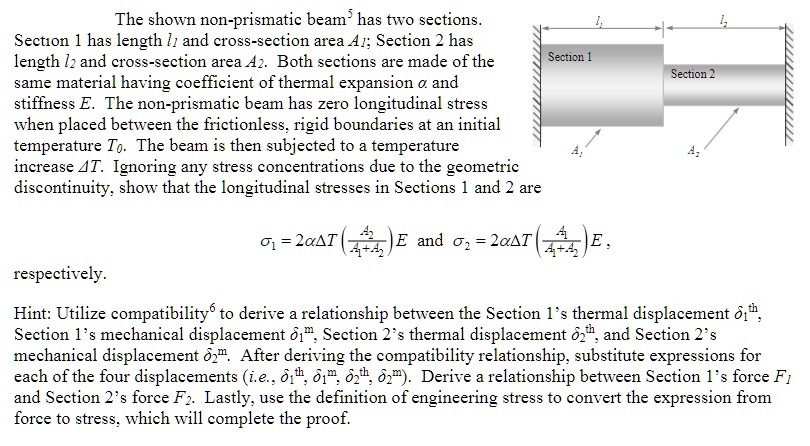
The shown non-prismatic beam$^5$ has two sections.
Section 1 has length $l_1$ and cross-section area $A_1$; Section 2 has
length $l_2$ and cross-section area $A_2$. Both sections are made of the
same material having coefficient of thermal expansion $\alpha$ and
stiffness $E$. The non-prismatic beam has zero longitudinal stress
when placed between the frictionless, rigid boundaries at an initial
temperature $T_0$. The beam is then subjected to a temperature
increase $\Delta T$. Ignoring any stress concentrations due to the geometric
discontinuity, show that the longitudinal stresses in Sections 1 and 2 are
$\sigma_1 = 2\alpha\Delta T \left(\frac{A_1}{A_1 + A_2}\right)E$ and $\sigma_2 = 2\alpha\Delta T \left(\frac{A_2}{A_1 + A_2}\right)E$,
respectively.
Hint: Utilize compatibility$^6$ to derive a relationship between the Section 1's thermal displacement $\delta_1^{th}$,
Section 1's mechanical displacement $\delta_1^m$, Section 2's thermal displacement $\delta_2^{th}$, and Section 2's
mechanical displacement $\delta_2^m$. After deriving the compatibility relationship, substitute expressions for
each of the four displacements (i.e., $\delta_1^{th}$, $\delta_1^m$, $\delta_2^{th}$, $\delta_2^m$). Derive a relationship between Section 1's force $F_1$
and Section 2's force $F_2$. Lastly, use the definition of engineering stress to convert the expression from
force to stress, which will complete the proof.