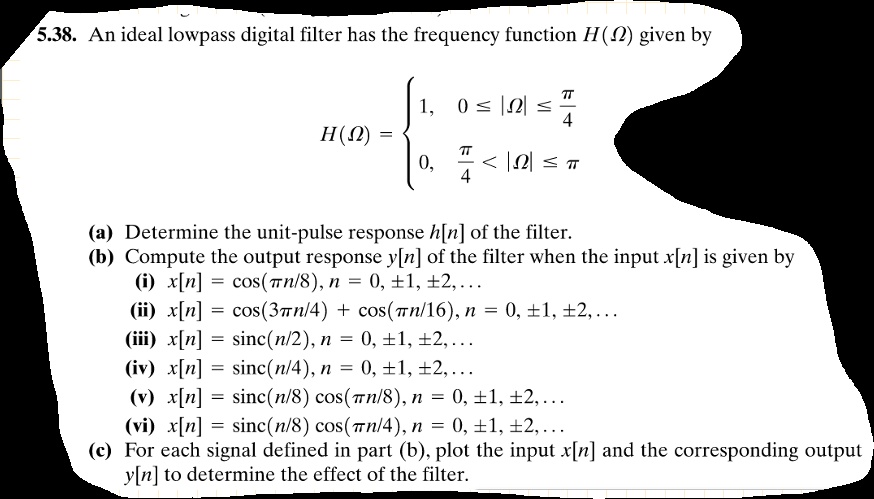
5.38. An ideal lowpass digital filter has the frequency function $H(\Omega)$ given by
$\begin{cases}
1, & 0 \le \Omega \le \frac{\pi}{4} \\
0, & \frac{\pi}{4} < \Omega \le \pi
\end{cases}$
(a) Determine the unit-pulse response $h[n]$ of the filter.
(b) Compute the output response $y[n]$ of the filter when the input $x[n]$ is given by
(i) $x[n] = \cos(\pi n/8)$, $n = 0, \pm 1, \pm 2,...$
(ii) $x[n] = \cos(3\pi n/4) + \cos(\pi n/16)$, $n = 0, \pm 1, \pm 2,...$
(iii) $x[n] = \text{sinc}(n/2)$, $n = 0, \pm 1, \pm 2,...$
(iv) $x[n] = \text{sinc}(n/4)$, $n = 0, \pm 1, \pm 2,...$
(v) $x[n] = \text{sinc}(n/8) \cos(\pi n/8)$, $n = 0, \pm 1, \pm 2,...$
(vi) $x[n] = \text{sinc}(n/8) \cos(\pi n/4)$, $n = 0, \pm 1, \pm 2,...$
(c) For each signal defined in part (b), plot the input $x[n]$ and the corresponding output
$y[n]$ to determine the effect of the filter.