Ace - AI Tutor
Ask Our Educators
Textbooks
My Library
Flashcards
Scribe - AI Notes
Notes & Exams
Download App
heather perez

heather p.

Divider

Questions asked

BEST MATCH

If the isoelectric point (pl) for an amino acid is at point A, what is the charge on the amino acid at point B? Equivalents OH- 00 O2 O-1 0 1 02

View Answer
divider
BEST MATCH

What is the best thing you can do to improve your chances of gaining acceptance in a graduate program in psychology? O do research O score high on the GRE O take many psychology courses O All of the above

View Answer
divider
BEST MATCH

Consider the circuit given below. 1Ω 5 A 4V V2 W 5Ω +- V3 2Ω 32 8 A Ref. If /= 9.000 A, determine the nodal voltages using the supernode technique. The value of the voltage (v1) = The value of the voltage (v2) = The value of the voltage (v3) = V. (Round the final answer to two decimal places. Include a minus sign if necessary.) V. (Round the final answer to three decimal places. Include a minus sign if necessary.) V. (Round the final answer to two decimal places. Include a minus sign if necessary.)

View Answer
divider
BEST MATCH

Describe a few arguments for and against hedge fund activism as an overall beneficial force (beyond hedge funds earning returns for their investors).

View Answer
divider
BEST MATCH

O Exponents Finding the final amount in a word problem on compound interest 3/5 SAM Kareem deposited $4000 into an account with 4.3% interest, compounded quarterly. Assuming that no withdrawals are made, how much will he have in the account after 5 years? Do not round any intermediate computations, and round your answer to the nearest cent. $ X 5

View Answer
divider
BEST MATCH

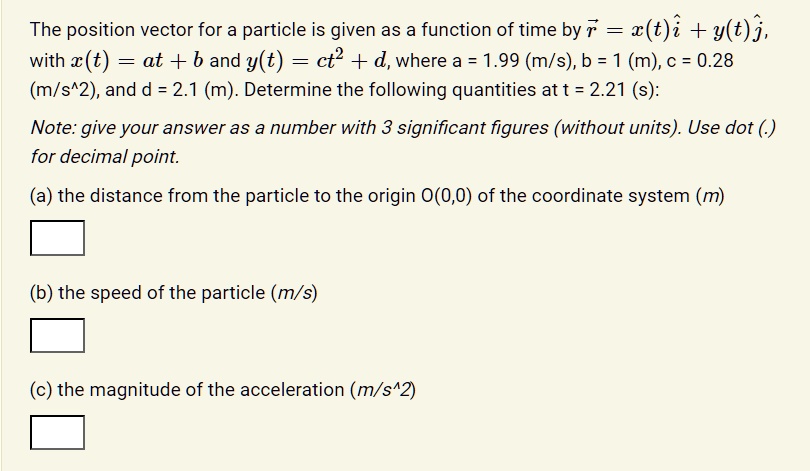
The position vector for a particle is given as a function of time by \(\vec{r} = x(t)\hat{i} + y(t)\hat{j}\), with \(x(t) = at + b\) and \(y(t) = ct^2 + d\), where \(a = 1.99\) (m/s), \(b = 1\) (m), \(c = 0.28\) (m/s^2), and \(d = 2.1\) (m). Determine the following quantities at \(t = 2.21\) (s): Note: give your answer as a number with 3 significant figures (without units). Use dot (.) for decimal point. (a) the distance from the particle to the origin O(0,0) of the coordinate system (m) (b) the speed of the particle (m/s) (c) the magnitude of the acceleration (m/s^2)
View Answer
divider
BEST MATCH

Problem 8 A control rod worth 60c of reactivity is half-inserted into a core of arbitrary height with a multiplication factor ($k_{eff}$) of 1. Determine the change in reactivity in pcm and its associated reactor period when: (b) the rod is instantaneously withdrawn to quarter insertion for two minutes. (b) the rod is then instantaneously inserted to 60% of its total length for thirty. (c) After the withdrawal and subsequent insertion, the rod is then returned to half-insertion. By how much has the reactor flux increased or decreased? The formula for differential rod worth with respect to height is: $\frac{dp_r}{dz} = \frac{p_r}{H}[1 - \cos\frac{2\pi z}{H}]$ where $p_r$ is total rod worth. (d) Is there a control rod configuration that could lead to prompt neutrons controlling the reaction? Instructor note: To lower the difficulty, use the non-differential form: $\rho(z) = p_r[1 - \frac{1}{2\pi}\sin\frac{2\pi z}{H}] \quad \epsilon \{0 \le z \le H\}$ Conversion that may come in handy: $\bullet$ 1 eV = 1.602 $\times$ 10$^{-19}$ J $\bullet$ 1 amu = 931.49 MeV $\bullet$ $N_A$ = 6.022 $\times$ 10$^{23}$ atoms/mol $\bullet$ 1 tonne = 1000 kg $\bullet$ 1 Ci = 3.7 $\times$ 10$^{10}$ Bq $\bullet$ 1 Gy = 100 rad $\bullet$ 1 Sv = 100 rem Recoverable energy from 1 fission process: 190 MeV NRC occupational exposure limit: 5 rem/y. Potentially useful atomic masses Radiation Quality Factors Isotope Atomic mass (u) Proton 1.007276466879 Neutron 1.00866491585 H-1 1.00782503223 H-2 2.01410177812 He-4 4.00260325413 O-16 15.99491461957 U-235 235.043930131 U-238 238.050788423 Type of Radiation QF X-rays, gamma rays 1 beta particles 1 alpha particles 20 thermal neutrons ($\le$ 1 keV) 2 fast neutrons ($\ge$ 1 MeV) 11

View Answer
divider
BEST MATCH

200 kip/ft 6 ft 12 ft 2 ft

View Answer
divider
BEST MATCH

Module 08: Discussion Many researchers praise the benefits of participative budgeting. Is it wise to involve multiple parties at multiple levels in the organization in the budget preparation process? In what ways can participative budgeting be used when creating a master budget for an organization? Further, explore the different components of the master budget and assess how each is linked to form a cohesive financial plan for a company to follow. How can participative budgeting make the master budgeting process more efficient and effective? Explain. Embed course material concepts, principles, and theories (which requires supporting citations) along with at least one scholarly, peer-reviewed reference supporting your answer. Keep in mind that these scholarly references can be found in the Saudi Electronic Library by conducting an advanced search specific to scholarly references. You are required to reply to at least two peer discussion question post answers to the weekly discussion question. These peer replies need to be substantial and constructive in nature. They should add to the content of the post and evaluate/analyze that answer. Normal course dialogue does not fulfill these two peer replies but is expected throughout the course. Answering all course questions is also required.

View Answer
divider
BEST MATCH

Problem 3: (23 pts) Consider the following table: X 1 1.1 1.2 1.3 1.4 cos(x) 0.54030 0.45360 0.36236 0.26750 0.16997 (i) [10 points] Using Newton Interpolation, write a program to obtain (ii) [2 points] A polynomial of degree 1 that interpolates $cos(x)$. (iii) [2 points] A polynomial of degree 2 that interpolates $cos(x)$. (iv) [2 points] A polynomial of degree 3 that interpolates $cos(x)$. (v) [2 points] A polynomial of degree 4 that interpolates $cos(x)$. (vi) [5 points] Compute $cos(1.05)$ using the various order polynomials and investigate the error for the Newton polynomial approximations in (ii) - (v)

View Answer
divider