Questions asked
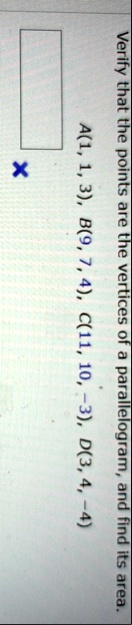
Verify that the points are the vertices of a parallelogram, and find its area. A(1, 1, 3), B(9, 7, 4), C(11, 10, -3), D(3, 4, -4) X
Question 4 (5 points) Retake question A 3000 lb 7° P 7° The 3000 lb weight is raised by the two 7 deg wedges shown in the figure. $\mu_s = 0.23$ for all surfaces. Determine minimum force of P (this puts things in a state of impending motion). Now solve for $F_{fricABot}$. Please round to the hundredth decimal place.
Many molluscs have a sharp, rasping tongue called O A foot. O A siphon. O A radula. O A mantle.
15. A baseball is thrown straight up with the initial speed of 50 ft/sec by a player who is 6 feet tall. Let $H(t)$ be the height of the ball above the ground $t$ seconds later. (a) Find a formula for $H(t)$. (b) When does the ball reach its maximum height and what is its maximum height? Round off your answers to two decimal places.
Fibrin is a soluble protein. ? True ? False
Adolescents conform less to peers and adults as their sense of __________________ grows Group of answer choices fear autonomy materialism intelligence
The distance between the slit and biprism and between biprism and screen are 50 cm each, Angle of biprism and refractive index are 179° and 1.5, respectively. Calculate the wavelength of light used if the distance between two successive fringes is 0.0135 m.. Give me correct solution........ don't slove using any Ai tools...
For the three statements below, 2.5 I. A problem in the class P can be solved in worst-case by a polynomial time algorithm. II. A problem in the class NP can be solved by a non-polynomial time algorithms III. A problem in the class NP can be verified in polynomial time Which one of the following is correct? [ A ] I is true, II and III are false [ B ] I and II are true but III is false [ C ] I and II are false but III is true [ D ] II is true but I and III is false [ E ] None of the above
R A B C D E F G H I Route sheet data for the parts Part Machine visit in sequence 1 R C D E B H G 2 R D E I F 3 R E I H G 4 R C F D E B 5 R D E I H G 6 R C D 7 R A B 8 R C F I 9 R B E 10 R E I F 11 R B I A 12 R A B G I
Match each description to the appropriate type of memory. Episodic Procedural Short-term also known as explicit memory also known as implicit memory memories that dissipate within seconds Answer Bank memory involving the development of learned skills memories of a specific life event also known as working memory