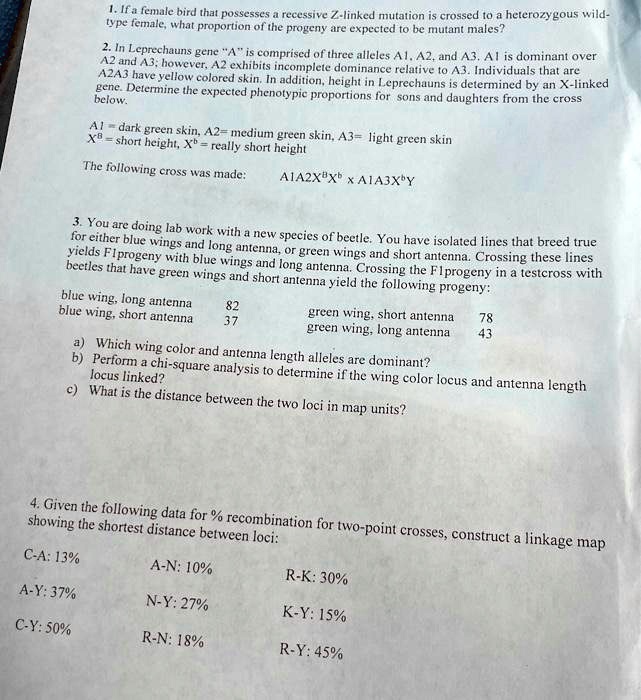
1. If a female bird that possesses a recessive Z-linked mutation is crossed to a heterozygous wild-
type female, what proportion of the progeny are expected to be mutant males?
2. In Leprechauns gene "A" is comprised of three alleles A1, A2, and A3. Al is dominant over
A2 and A3; however, A2 exhibits incomplete dominance relative to A3. Individuals that are
A2A3 have yellow colored skin. In addition, height in Leprechauns is determined by an X-linked
gene. Determine the expected phenotypic proportions for sons and daughters from the cross
below.
A1 = dark green skin, A2 = medium green skin, A3 = light green skin
$X^b$ = short height, $X^B$ = really short height
The following cross was made:
$A1A2X^BX^b \times A1A3X^BY$
3. You are doing lab work with a new species of beetle. You have isolated lines that breed true
for either blue wings and long antenna, or green wings and short antenna. Crossing these lines
yields F1 progeny with blue wings and long antenna. Crossing the F1 progeny in a testcross with
beetles that have green wings and short antenna yield the following progeny:
blue wing, long antenna 82 green wing, short antenna 78
blue wing, short antenna 37 green wing, long antenna 43
a) Which wing color and antenna length alleles are dominant?
b) Perform a chi-square analysis to determine if the wing color locus and antenna length
locus linked?
c) What is the distance between the two loci in map units?
4. Given the following data for % recombination for two-point crosses, construct a linkage map
showing the shortest distance between loci:
C-A: 13% A-N: 10% R-K: 30%
A-Y: 37% N-Y: 27% K-Y: 15%
C-Y: 50% R-N: 18% R-Y: 45%