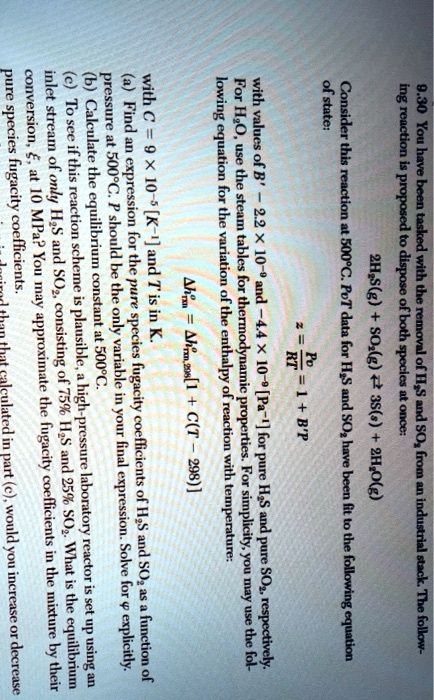
9.30 You have been tasked with the removal of H?S and SO? from an industrial stack. The following reaction is proposed to dispose of both species at once:
2H?S(g) + SO?(g) ? 3S(s) + 2H?O(g)
Consider this reaction at 500°C. $P^{0T}$ data for H?S and SO? have been fit to the following equation
of state:
$z = \frac{P_0}{RT} = 1 + B'P$
with values of $B' = 2.2 \times 10^{-9}$ and $-4.4 \times 10^{-9}$ [Pa?¹] for pure H?S and pure SO?, respectively.
For H?O, use the steam tables for thermodynamic properties. For simplicity, you may use the following equation for the variation of the enthalpy of reaction with temperature:
$\Delta H_r = \Delta H_{r,298} [1 + C(T - 298)]$
with $C = 9 \times 10^{-5}$ [K?¹] and $T$ is in K.
(a) Find an expression for the pure species fugacity coefficients of H?S and SO? as a function of
pressure at 500°C. $P$ should be the only variable in your final expression. Solve for $\phi$ explicitly.
(b) Calculate the equilibrium constant at 500°C.
(c) To see if this reaction scheme is plausible, a high-pressure laboratory reactor is set up using an
inlet stream of only H?S and SO?, consisting of 75% H?S and 25% SO?. What is the equilibrium
conversion, $\xi$, at 10 MPa? You may approximate the fugacity coefficients in the mixture by their
pure species fugacity coefficients.