9:32 AM
50
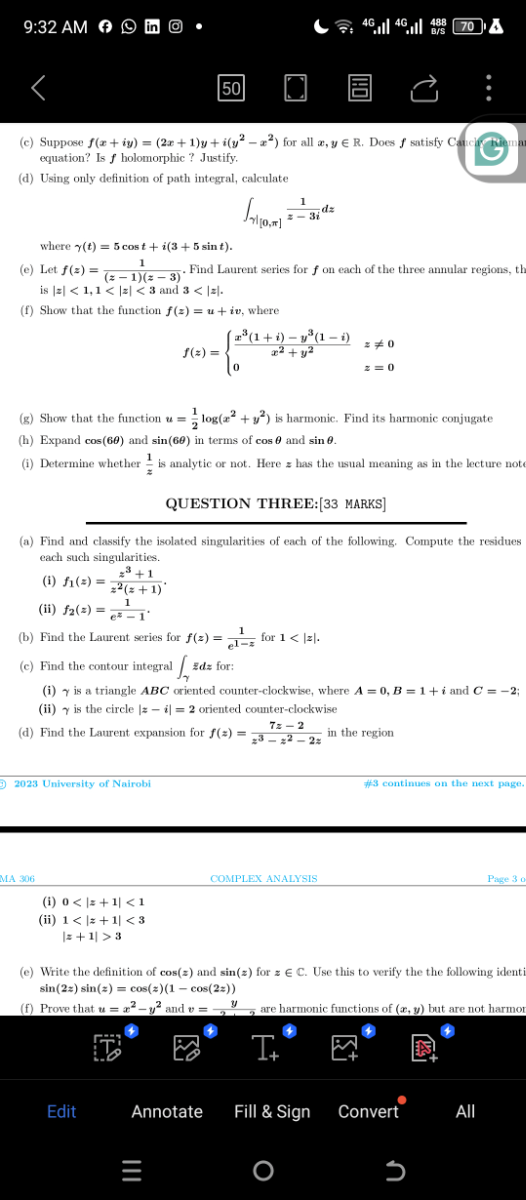
(c) Suppose \( f(x+i y)=(2 x+1) y+i\left(y^{2}-x^{2}\right) \) for all \( x, y \in \mathrm{R} \). Does \( f \) satisfy \( \mathrm{C} \) equation? Is \( f \) holomorphic ? Justify.
(d) Using only definition of path integral, calculate
\[
\int_{\gamma[0, \pi]} \frac{1}{z-3 i} d z
\]
where \( \gamma(t)=5 \cos t+i(3+5 \sin t) \).
(e) Let \( f(z)=\frac{1}{(z-1)(z-3)} \). Find Laurent series for \( f \) on each of the three annular regions, th is \( |z|<1,1<|z|<3 \) and \( 3<|z| \).
(f) Show that the function \( f(z)=u+i v \), where
\[
f(z)=\left\{\begin{array}{ll}
\frac{x^{3}(1+i)-y^{3}(1-i)}{x^{2}+y^{2}} & z \neq 0 \\
0 & z=0
\end{array}\right.
\]
(g) Show that the function \( u=\frac{1}{2} \log \left(x^{2}+y^{2}\right) \) is harmonic. Find its harmonic conjugate
(h) Expand \( \cos (6 \theta) \) and \( \sin (6 \theta) \) in terms of \( \cos \theta \) and \( \sin \theta \).
(i) Determine whether \( \frac{1}{z} \) is analytic or not. Here \( z \) has the usual meaning as in the lecture not.
QUESTION THREE:[33 MARKS]
(a) Find and classify the isolated singularities of each of the following. Compute the residues each such singularities.
(i) \( f_{1}(z)=\frac{z^{3}+1}{z^{2}(z+1)} \).
(ii) \( f_{2}(z)=\frac{1}{e^{z}-1} \).
(b) Find the Laurent series for \( f(z)=\frac{1}{e^{1-z}} \) for \( 1<|z| \).
(c) Find the contour integral \( \int_{\gamma} \approx d z \) for:
(i) \( \gamma \) is a triangle \( A B C \) oriented counter-clockwise, where \( A=0, B=1+i \) and \( C=-2 \);
(ii) \( \gamma \) is the circle \( |z-i|=2 \) oriented counter-clockwise
(d) Find the Laurent expansion for \( f(z)=\frac{7 z-2}{z^{3}-z^{2}-2 z} \) in the region
2023 University of Nairobi
\#3 continues on the next page.
(i) \( 0<|z+1|<1 \)
(ii)
\[
\begin{array}{l}
1<|z+1|<3 \\
|z+1|>3
\end{array}
\]
(e) Write the definition of \( \cos (z) \) and \( \sin (z) \) for \( z \in \mathbb{C} \). Use this to verify the the following identi \( \sin (2 z) \sin (z)=\cos (z)(1-\cos (2 z)) \)
(f) Prove that \( u=x^{2}-y^{2} \) and \( v=\frac{y}{2} \) are harmonic functions of ( \( x, y \) ) but are not harmol
Edit
Annotate
Fill \& Sign
Convert
All