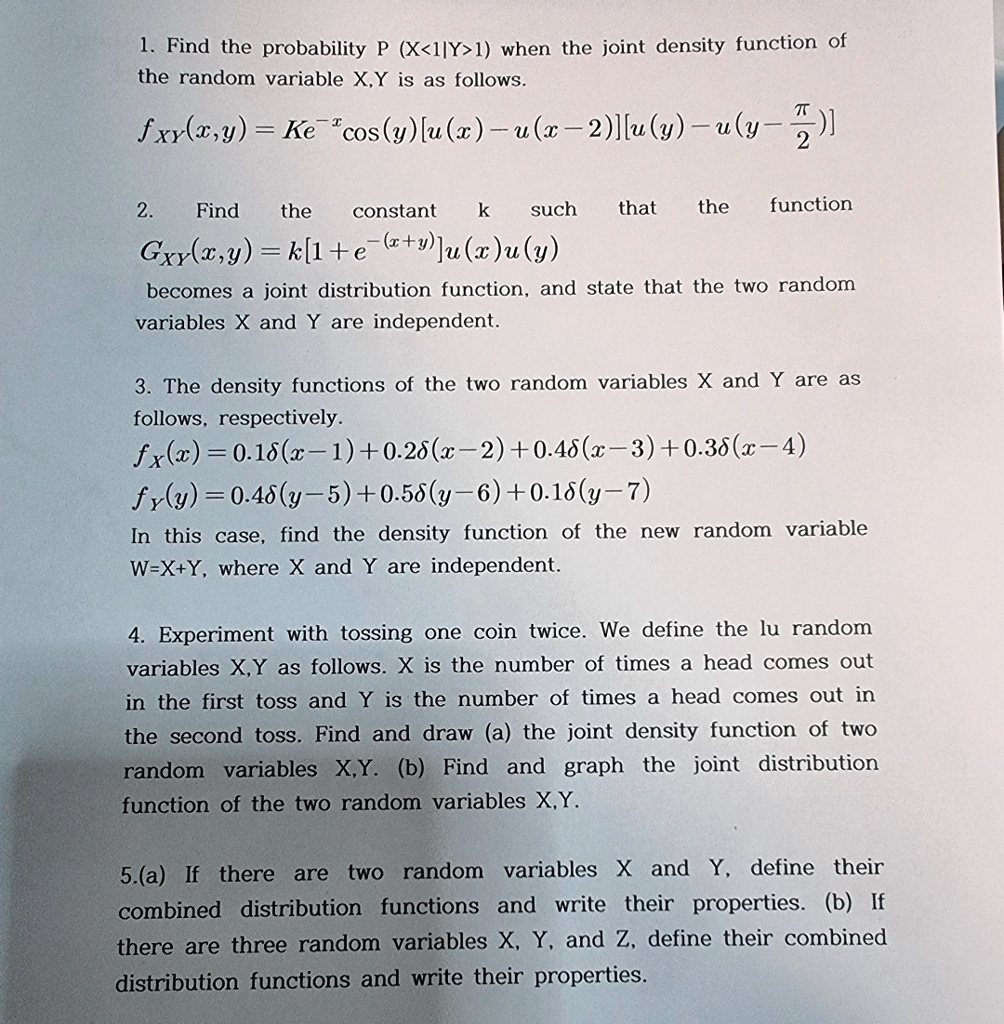
1. Find the probability P(x<1|Y>1) when the joint density function of the random variables x, Y is as follows:
f_(XY)(x,y) = Ke^(-x)cos(y)[u(x)-u(x-2)][u(y)-u(y-(π)/(2))]
2. Find the constant k such that the function:
G_(XY)(x,y) = k[1+e^(-(x+y))]u(x)u(y)
becomes a joint distribution function, and state that the two random variables x and Y are independent.
3. The density functions of the two random variables x and Y are as follows, respectively:
f_(X)(x) = 0.1δ(x-1) + 0.2δ(x-2) + 0.4δ(x-3) + 0.3δ(x-4)
f_(Y)(y) = 0.4δ(y-5) + 0.5δ(y-6) + 0.1δ(y-7)
In this case, find the density function of the new random variable W = x + Y, where x and Y are independent.
4. Experiment with tossing one coin twice. We define the random variables X, Y as follows: X is the number of times a head comes out in the first toss and Y is the number of times a head comes out in the second toss. Find and draw (a) the joint density function of the two random variables X, Y. (b) Find and graph the joint distribution function of the two random variables X, Y.
5. (a) If there are two random variables X and Y, define their combined distribution functions and write their properties. (b) If there are three random variables X, Y, and Z, define their combined distribution functions and write their properties.