Ace - AI Tutor
Ask Our Educators
Textbooks
My Library
Flashcards
Scribe - AI Notes
Notes & Exams
Download App
hector jensen

hector j.

Divider

Questions asked

BEST MATCH

Balance the below redox reaction in an acidic solution. Use the blanks next to each component to indicate stoichiometry of that component, and use the blanks on either side of the reaction to include additional components needed for balance. You must show some intermediate work here to receive credit for your answer.

View Answer
divider
BEST MATCH

f(x) = 4x^3 - 3x^2 - 36x + 5 (a) Find the critical number(s). First, find f'(x). f'(x) = f(=4-3-36+5 aFind the critical number(s). First, find f(x).

View Answer
divider
BEST MATCH

(c) What sequence of reactions could be used to ensure the following transformation?

View Answer
divider
BEST MATCH

D % protein, 2% carbohydrates perwent water is present in the body? What if another person was 37% water what is the remainder (content and percentages)? 6. (2 points) Give the chemical formulas for the following ions and molecules. Potassium jon Glucose Water Magnesium ion 7. (2 points) Name the element/ ion/ molecule for each of the chemical formulas below: $HCO_3$ C $Na^+$ P

View Answer
divider
BEST MATCH

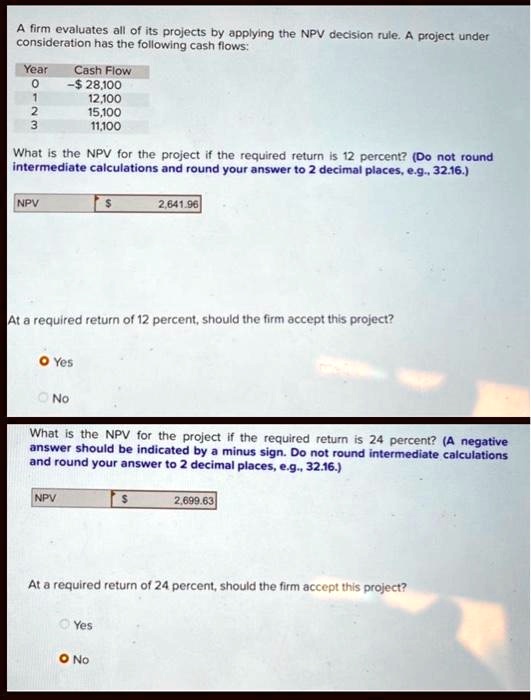
A firm evaluates all of its projects by applying the NPV decision rule. A project under consideration has the following cash flows: Year Cash Flow 0 -$ 28,100 1 12,100 2 15,100 3 11,100 What is the NPV for the project if the required return is 12 percent? (Do not round intermediate calculations and round your answer to 2 decimal places, e.g., 32.16.) NPV $ 2,641.96 At a required return of 12 percent, should the firm accept this project? Yes No What is the NPV for the project if the required return is 24 percent? (A negative answer should be indicated by a minus sign. Do not round intermediate calculations and round your answer to 2 decimal places, e.g., 32.16.) NPV $ 2,699.63 At a required return of 24 percent, should the firm accept this project? Yes No
View Answer
divider
BEST MATCH

Consider an object which falls freely near sea level whose mass is $m = \frac{g}{\gamma}$ where $g$ is the gravity constant and drag force is $\gamma v^2$. Assume $v(0) = 0$ then $\lim_{t \to \infty} v(t) = $

View Answer
divider
BEST MATCH

Texts: A simple random sample of size n is drawn from a population that is known to be normally distributed. The sample variance, s^2, is determined to be 12.6. Construct a 90% confidence interval for σ^2 if the sample size, n, is 20. Construct a 90% confidence interval for σ^2 if the sample size, n, is 30. How does increasing the sample size affect the width of the interval? Construct a 98% confidence interval for σ^2 if the sample size, n, is 20. Compare the results with those obtained in part (a). How does increasing the confidence level affect the width of the confidence interval?

View Answer
divider
BEST MATCH

CL03: Write a Python program that determines the ticket price based on the age of the person. This program should ask the user to enter the age of a person, then the price will be displayed according to the criteria: Age Ticket Price from 0 to less than 12 60 AED from 12 to less than 18 100 AED 18 and more 150 AED

View Answer
divider
BEST MATCH

What is the organizer? What did the Spemann and Mangold experiments show? Why is beta-catenin important—where is it expressed, what does it do? Know the signaling cascade/mechanism that sets up beta-catenin localization. What role does nodal signaling play in dorsal fate? Know the key markers for the dorsal blastopore. These proteins are involved in specifying the head endomesoderm and the neural plate. How do gradients of BMP and Wnt establish the D-V and A-P axis, respectively? What other players besides Wnts may be important for A-P axis formation? How is the left-right axis specified in amphibians?

View Answer
divider
BEST MATCH

In Exercises 1-9, prove each of the given statements from the given premises. You may use any of the following statements, with all occurrences of a letter replaced by a particular statement, as premises. I) (P → S) ↔ (¬S → ¬P) II) ¬Q ∧ (S ∨ Q) → S III) ¬¬R ↔ R IV) P → P ∨ R In Exercises 1-7, use direct proofs.

View Answer
divider