The text provided contains several spelling, typographical, and grammatical errors. Additionally, there are formatting issues and mathematical errors related to the square root symbol. The correct version of the text is as follows:
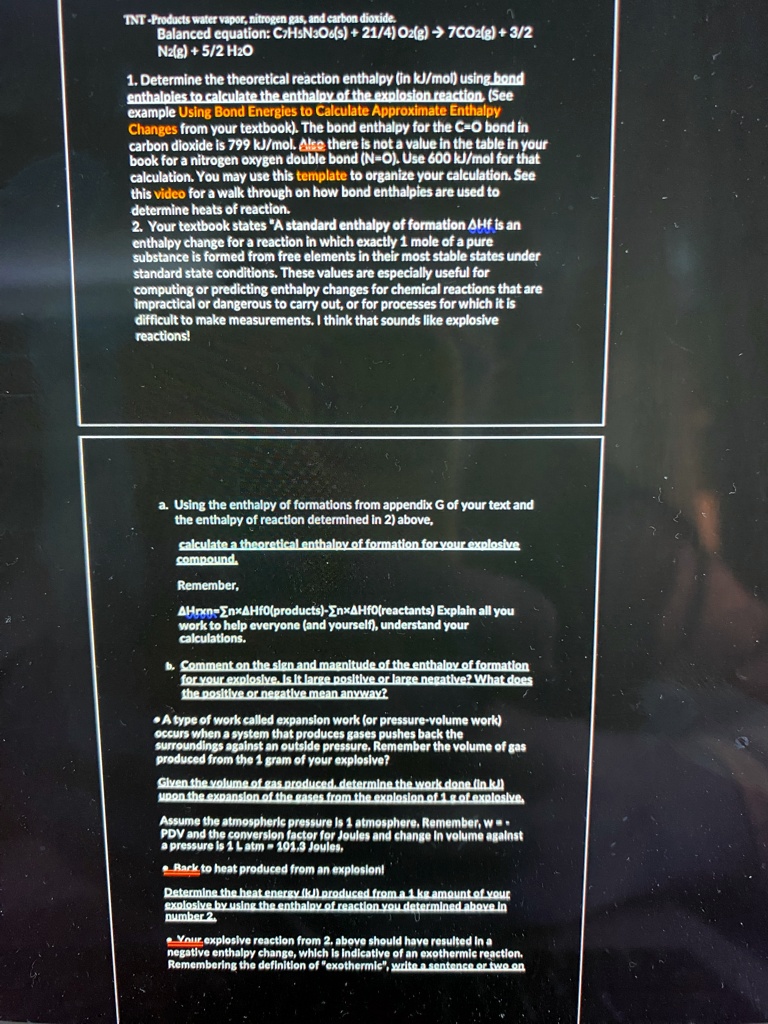
TNT - Products water vapor, nitrogen gas, and carbon dioxide.
Balanced equation: C7H5N3O6(s) + 21/4 O2(g) → 7CO2(g) + 3/2 N2(g) + 5/2 H2O
1. Determine the theoretical reaction enthalpy (in kJ/mol) using bond enthalpies to calculate the enthalpy of the explosion reaction. (See example Using Bond Energies to Calculate Approximate Enthalpy Changes from your textbook). The bond enthalpy for the C=O bond in carbon dioxide is 799 kJ/mol. Also, there is not a value in the table in your book for a nitrogen-oxygen double bond (N=O). Use 600 kJ/mol for that calculation. You may use this template to organize your calculation. See this video for a walk-through on how bond enthalpies are used to determine heats of reaction.
2. Your textbook states, “A standard enthalpy of formation ΔHf is an enthalpy change for a reaction in which exactly 1 mole of a pure substance is formed from free elements in their most stable states under standard state conditions. These values are especially useful for computing or predicting enthalpy changes for chemical reactions that are impractical or dangerous to carry out, or for processes for which it is difficult to make measurements. I think that sounds like explosive reactions!
a. Using the enthalpy of formations from appendix G of your text and the enthalpy of reaction determined in 2) above, calculate a theoretical enthalpy of formation for your explosive compound.
Remember,
ΔHrxn = ∑n × ΔHf0(products) - ∑n × ΔHf0(reactants) Explain all your work to help everyone (and yourself) understand your calculations.
b. Comment on the sign and magnitude of the enthalpy of formation for your explosive. Is it large positive or large negative? What does the positive or negative mean anyway?
• A type of work called expansion work (or pressure-volume work) occurs when a system that produces gases pushes back the surroundings against an outside pressure. Remember the volume of gas produced from the 1 gram of your explosive?
Given the volume of gas produced, determine the work done (in kJ) upon the expansion of the gases from the explosion of 1 g of explosive.
Assume the atmospheric pressure is 1 atmosphere. Remember, w = -PDV and the conversion factor for Joules and change in volume against a pressure is 1 L atm = 101.3 Joules.
• Back to heat produced from an explosion!
Determine the heat energy (kJ) produced from a 1 kg amount of your explosive by using the enthalpy of reaction you determined above in number 2.
• Your explosive reaction from 2. above should have resulted in a negative enthalpy change, which is indicative of an exothermic reaction. Remembering the definition of “exothermic”, write a sentence or two on how this “exothermicity” may affect the value for the volume of gas you used to calculate expansion work in #4.