Ace - AI Tutor
Ask Our Educators
Textbooks
My Library
Flashcards
Scribe - AI Notes
Notes & Exams
Download App
Heidi Michaud

Heidi M.

Divider

Viewed Questions

Eleven employees were put under the care of the company nurse because of high cholesterol readings. The nurse lectured them on the dangers of this condition and put them on a new diet. Shown are the cholesterol readings of the 11 employees both before the new diet and one month after use of the diet began. Construct a $98 \%$ confidence interval to estimate the population mean difference of cholesterol readings for people who are involved in this program. Assume differences in cholesterol readings are normally distributed in the population. $$ \begin{array}{|c|c|c|} \hline \text { Employee } & \text { Before } & \text { After } \\ \hline 1 & 255 & 197 \\ \hline 2 & 230 & 225 \\ \hline 3 & 290 & 215 \\ \hline 4 & 242 & 215 \\ \hline 5 & 300 & 240 \\ \hline \end{array} $$ $$ \begin{array}{ccc} \text { Employee } & \text { Before } & \text { After } \\ 6 & 250 & 235 \\ 7 & 215 & 190 \\ 8 & 230 & 240 \\ 9 & 225 & 200 \\ 10 & 219 & 203 \\ 11 & 236 & 223 \end{array} $$

Business Statistics - For Contemporary Decision Making

Statistical Inferences About Two…

Statistical Inferences for Two Related…

Questions asked

ANSWERED

Joshua Argo verified

Numerade educator

According to Statistics Canada (for 2017), 60% of all Canadian households have an air conditioner and 81% have trees on their property. Suppose 91% of all Canadian households with an air conditioner have trees on their property. A Canadian household is randomly selected. 1. What is the probability that the household has an air conditioner and trees on the property? 2. What is the probability that the household has an air conditioner or trees on the property? 3. What is the probability that the household has an air conditioner and does not have any trees on the property? 4. What is the probability that the household has neither an air conditioner nor trees on the property? 5. What is the probability that the household does not have an air conditioner and does have trees on the property?

View Answer
divider
ANSWERED

Paul A. verified

Numerade educator

Eleven employees were put under the care of the company nurse because of high cholesterol readings. The nurse lectured them on the dangers of this condition and put them on a new diet. Shown are the cholesterol readings in millimoles per litre (mmol/L) of the 11 employees both before the new diet and one month after use of the diet began. Construct a 98% confidence interval to estimate the population mean difference of cholesterol readings for people who are involved in this program. Assume differences in cholesterol readings are normally distributed in the population. Employee Before After 1 6.59 5.09 2 5.95 5.82 3 7.50 5.56 4 6.26 5.56 5 7.76 6.21 6 6.46 6.08 7 5.56 4.91 8 5.95 6.21 9 5.82 5.17 10 5.66 5.25 11 6.10 5.77

View Answer
divider
INSTANT ANSWER

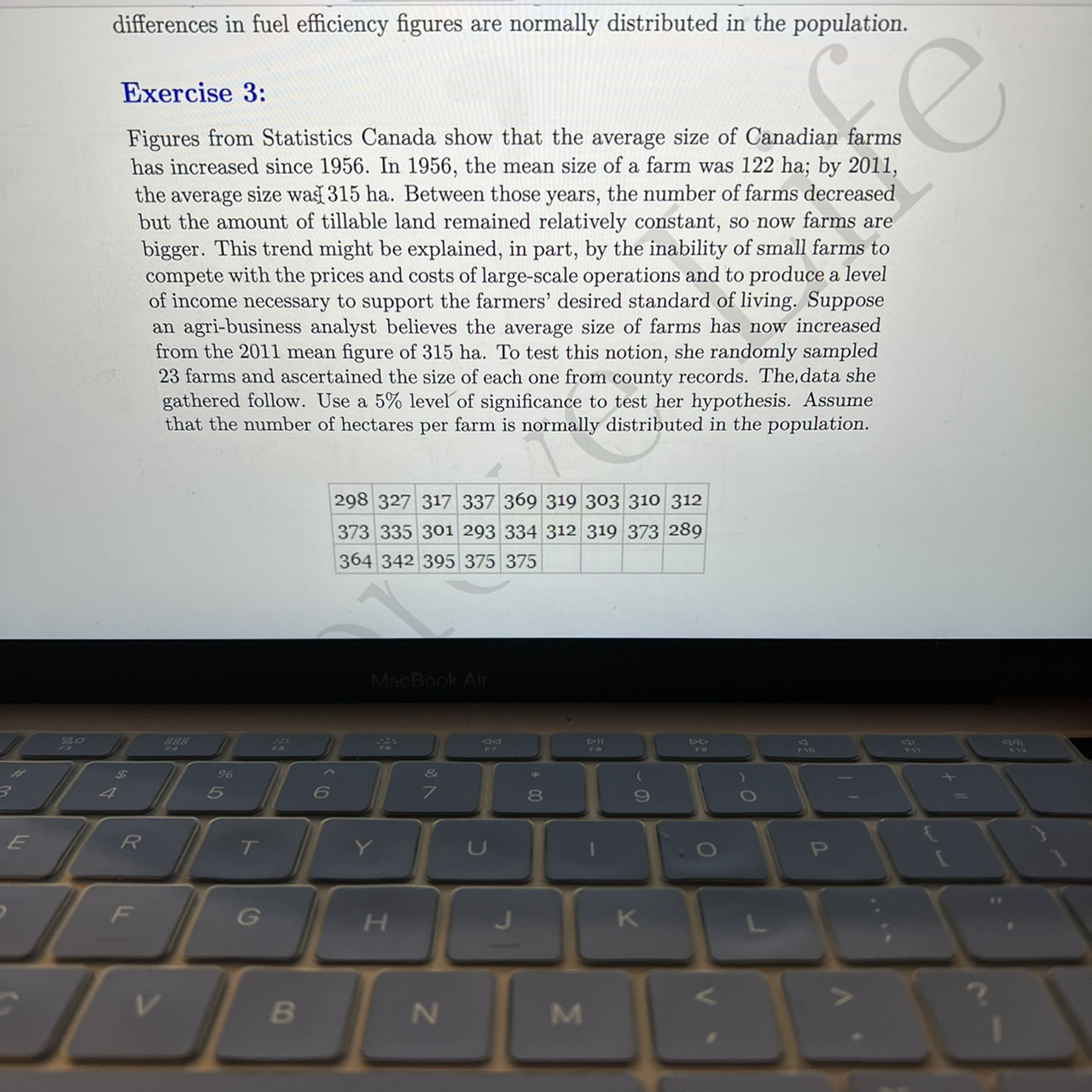
differences in fuel efficiency figures are normally distributed in the population. Exercise 3: Figures from Statistics Canada show that the average size of Canadian farms has increased since 1956. In 1956, the mean size of a farm was 122 ha; by 2011 , the average size wax 315 ha. Between those years, the number of farms decreased but the amount of tillable land remained relatively constant, so now farms are bigger. This trend might be explained, in part, by the inability of small farms to compete with the prices and costs of large-scale operations and to produce a level of income necessary to support the farmers' desired standard of living. Suppose an agri-business analyst believes the average size of farms has now increased from the 2011 mean figure of 315 ha. To test this notion, she randomly sampled 23 farms and ascertained the size of each one from county records. The,data she gathered follow. Use a \( 5 \% \) level of significance to test her hypothesis. Assume that the number of hectares per farm is normally distributed in the population. \begin{tabular}{|l|l|l|l|l|l|l|l|l|} \hline 298 & 327 & 317 & 337 & 369 & 319 & 303 & 310 & 312 \\ \hline 373 & 335 & 301 & 293 & 334 & 312 & 319 & 373 & 289 \\ \hline 364 & 342 & 395 & 375 & 375 & & & & \\ \hline \end{tabular}
View Answer
divider