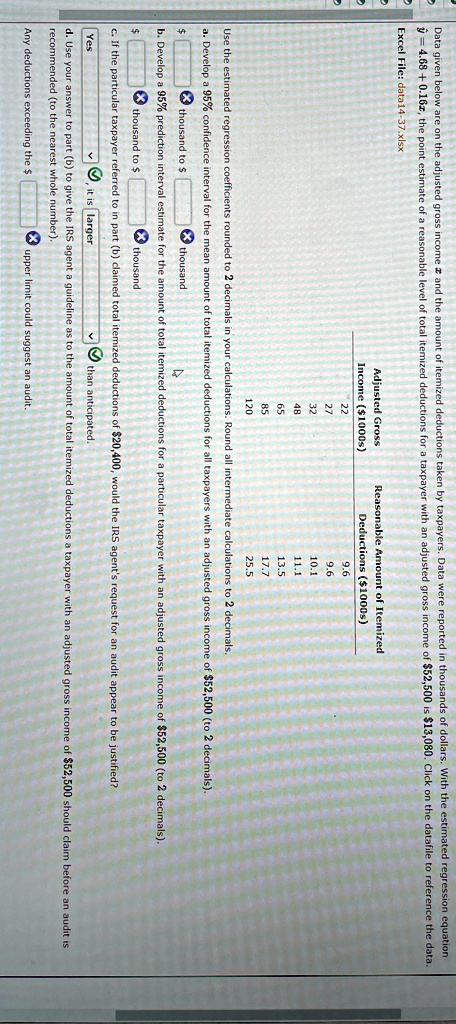
Data given below are on the adjusted gross income z and the amount of itemized deductions taken by taxpayers. Data were reported in thousands of dollars. With the estimated regression equation
$\hat{y} = 4.68 + 0.16z$, the point estimate of a reasonable level of total itemized deductions for a taxpayer with an adjusted gross income of $52,500 is $13,080. Click on the datafile to reference the data.
Excel File: data14-37.xlsx
Adjusted Gross
Income ($1000s)
22
27
32
48
65
85
120
Reasonable Amount of Itemized
Deductions ($1000s)
9.6
9.6
10.1
11.1
13.5
17.7
25.5
Use the estimated regression coefficients rounded to 2 decimals in your calculations. Round all intermediate calculations to 2 decimals.
a. Develop a 95% confidence interval for the mean amount of total itemized deductions for all taxpayers with an adjusted gross income of $52,500 (to 2 decimals).
$ thousand to $ thousand
b. Develop a 95% prediction interval estimate for the amount of total itemized deductions for a particular taxpayer with an adjusted gross income of $52,500 (to 2 decimals).
$ thousand to $ thousand
c. If the particular taxpayer referred to in part (b) claimed total itemized deductions of $20,400, would the IRS agent's request for an audit appear to be justified?
Yes
✔✔✔, it is larger
✔✔ than anticipated.
d. Use your answer to part (b) to give the IRS agent a guideline as to the amount of total itemized deductions a taxpayer with an adjusted gross income of $52,500 should claim before an audit is
recommended (to the nearest whole number).
Any deductions exceeding the $ upper limit could suggest an audit.