1. Monopoly versus perfect competition
Consider the daily market for hot dogs in a small city. Suppose that this market is in long-run competitive equilibrium, with many hot dog stands in
the city, each one selling the same kind of hot dogs. Therefore, each vendor is a price taker and possesses no market power.
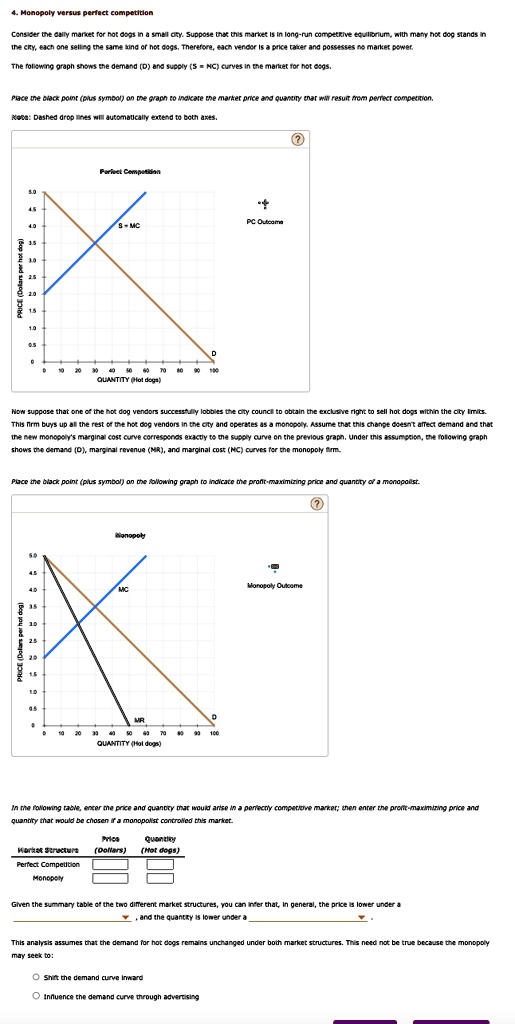
The following graph shows the demand (D) and supply (S = MC) curves in the market for hot dogs.
Place the black point (plus symbol) on the graph to indicate the market price and quantity that will result from perfect competition.
Note: Dashed drop lines will automatically extend to both axes.
Perfect Competition
S = MC
PC Outcome
PRICE (Dollars per hot dog)
QUANTITY (Hot dogs)
Now suppose that one of the hot dog vendors successfully lobbies the city council to obtain the exclusive right to sell hot dogs within the city limits.
This firm buys up all of the rest of the hot dog vendors in the city and operates as a monopoly. Assume that this change doesn't affect demand and that
the new monopoly's marginal cost curve corresponds exactly to the supply curve on the previous graph. Under this assumption, the following graph
shows the demand (D), marginal revenue (MR), and marginal cost (MC) curves for the monopoly firm.
Place the black point (plus symbol) on the following graph to indicate the profit-maximizing price and quantity of a monopolist.
Monopoly
MC
MR
Monopoly Outcome
PRICE (Dollars per hot dog)
QUANTITY (Hot dogs)
In the following table, enter the price and quantity that would arise in a perfectly competitive market; then enter the profit-maximizing price and
quantity that would be chosen if a monopolist controlled this market.
Market Structure Price Quantity
(Dollars) (Hot dogs)
Perfect Competition
Monopoly
Given the summary table of the two different market structures, you can infer that, in general, the price is lower under a
and the quantity is lower under a
This analysis assumes that the demand for hot dogs remains unchanged under both market structures. This need not be true because the monopoly may seek to:
? Shift the demand curve inward
? Influence the demand curve through advertising