Ace - AI Tutor
Ask Our Educators
Textbooks
My Library
Flashcards
Scribe - AI Notes
Notes & Exams
Download App
helen ju-rez

helen j.

Divider

Questions asked

BEST MATCH

Find the limit. Use l'Hospital's Rule where appropriate. If there is a more elementary method, consider using it. lim t→0 e^4t − 1 / sin(t)

View Answer
divider
BEST MATCH

The Herfindahl-Hirschman index equals \_\_\_\_\_ when \_\_\_\_\_ have/has \_\_\_\_\_% of the market. 5,000; two firms each; 50 10,000; four firms each; 25 100,000; one firm; 100 5,000; three firms each; 33

View Answer
divider
BEST MATCH

\( \lim _{x \rightarrow 2^{-}} \frac{x^{3}-8}{x-2} \)

View Answer
divider
BEST MATCH

I.1.8.Application: Consider the ways in which the concepts or thought experiments apply to the chapter. Use the thought experiment to explain a particular claim to truth or value . You may apply a thought experiment to the subject of racism, etc. 1. Racism- 2. Climate Change 3. Moral Education 4. Abortion

View Answer
divider
BEST MATCH

Vicarious trauma is where the client absorbs his or her social worker's trauma. Select one: O True O False

View Answer
divider
BEST MATCH

- Produce the Work Breakdown Structure (WBS) of a medium-sized PV Energy Park in Greece - Use Gantt Chart methodology to present detailed activities sequence according to the above-mentioned WBS - Estimate indicative costs per category of equipment and installation activity - Estimate indicative cash flows (annual turnover and operational costs) over a period of 20 years - Based on the above-mentioned cash flows and initial amount of investment, use the NPV and Profitability Index methods in order to evaluate the investment

View Answer
divider
BEST MATCH

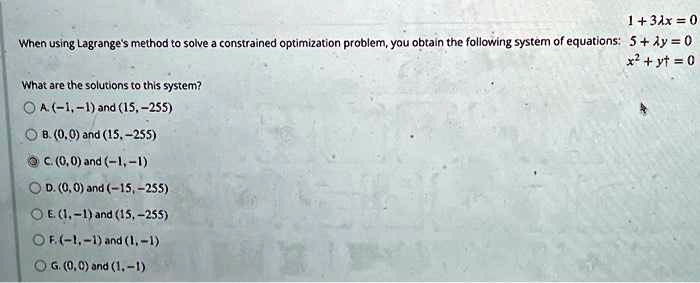
1 + 3?x = 0 When using Lagrange's method to solve a constrained optimization problem, you obtain the following system of equations: 5 + ?y = 0 x² + yt = 0 What are the solutions to this system? A. (-1, -1) and (15, -255) B. (0, 0) and (15, -255) C. (0, 0) and (-1, -1) D. (0, 0) and (-15, -255) E. (1, -1) and (15, -255) F. (-1, -1) and (1, -1) G. (0, 0) and (1, -1)
View Answer
divider
BEST MATCH

a) The rotating step shaft is subjected to the force as shown in the figure. It is supported by bearings at A and F. The shaft is machined using AISI 1040 CD steel. Determine the minimum fatigue factor of safety based on achieving infinite life. If infinite life is not predicted, estimate the number of cycles to failure. Also check for yielding. Given Data: (Notch sensitivity (q)=0.85, $S_{ut}$=85 kpsi, $S_{yield}$= 71 kpsi, Surface condition modification factor $k_a$=0.868, Size modification factor $k_b$=0.8, Load modification factor $k_c$=1, fatigue fraction (f)=0.867) * In order to determine $K_t$; Use Figure A-15-9 in your textbook. y 1150 lbf Dimensions are in inch and all fillet radius: 1/6 inch 1.8 1.0 B A 1.2 D C E F 1.0 $R_1$ -0.5 ? 8 8.5 ? 19.5 20 $R_2$ x b) In this part, assume that; the shaft has constant circular cross-section and its diameter is 0.6 inch along the shaft. The same magnitude of load is applied in the middle of shaft as shown in the figure below. Bearings are still at the same locations (at the ends). Calculate the maximum deflection under applied load. Take Elasticity Modulus as 210 GPa. 1150 lbf 0.6 inch 10 inch 10 inch $R_1$ $R_2$ x

View Answer
divider
BEST MATCH

(10 points) The diagram on the left below shows a configuration in which there is uniform heat generation in the material labeled \"A\". This material is insulated on the left side. Material \"B\" has no generation. The thermal conductivity of \"B\" is less than that of \"A\". An engineer at your company has modeled the problem and has presented you with a temperature profile they have calculated on the right. Since you know heat transfer well, you find several errors with their solution. List three errors that this engineer has made in this temperature graph and explain why they are incorrect. These are conceptual. Insulated L h Tfluid = 20 °C KA ?gen KB < KA X Temperature, °C Temperature vs Position 250 200 150 100 50 0 0 L Position, x 2L Here are some formulas for heat generation that you might find helpful. Plane wall with generation, asymmetric: $T(x) = \frac{\dot{e}_{gen}L^2}{2k} \left(1 - \frac{x^2}{L^2}\right) + \frac{T_2 + T_1}{2} + \frac{T_1 + T_2}{2}$ Symmetrical boundary conditions, planar wall: $T(x) = \frac{\dot{e}_{gen}L^2}{2k} \left(1 - \frac{x^2}{L^2}\right) + T_1$ $T_s, \text{ plane wall} = T_{\infty} + \frac{\dot{e}_{gen}L}{h}$ parabolic

View Answer
divider
BEST MATCH

Write the INITIAL simplex matrix for the following standard maximization problem: Maximize $f = 3x + 3y$ subject to the constraints $1x + 6y \le 21$ $4x + 7y \le 20$ $x \ge 0$ $y \ge 0$ DO NOT SOLVE

View Answer
divider