Questions asked
The amount of sampling error in a poll is called the
The two studies attached below evaluate the performance of a specific type of mental health service intervention known as Supported Education. This intervention supports people in recovery from mental illness who are attending college level educational programs. The program is considered an "Evidence-based Practice" and the two evaluation studies attached below provide partial evidence in support of that designation. They are of interest because they each use different methods to evaluate the effectiveness of the program. While one study uses a quantitative approach to evaluate service outcomes, the other uses qualitative methods to assess the long term impact of the program from the student's own experience and understand the factors that contributed to variance on service outcomes and unanticipated outcomes, i.e., why some students succeeded in the program while others did not. One is an example of "performance measurement," while the other is an example of "impact evaluation." They are instructive in that they each look at the same type of program but use different evaluation methods to provide different kinds of information. Taken together, they provide two different "lenses" to evaluate the program and demonstrate the value of using both quantitative and qualitative approaches when developing a plan to investigate program performance. For this discussion, please read the two articles and compare the merits of each evaluation method. Be sure to discuss the following: Briefly describe the findings for each study and note if the findings were similar or different in any way.
Consider a firm with a contract to sell an asset for $153,000 four years from now. The asset costs $99,000 to produce today.
9 (5 points) Saved Hooke's Law = Fspr = k\Delta L or -kx Fspr = kt or -kt Fspr = -kL or -kd
Solve. (x)/(5)-(x)/(6)=(7)/(6) x= (Simplify your answer. Type an integer or a fraction.) Solve. KK X 15 X 7 X= (Simplify your answer. Type an integer or a fraction.)
1. A mechanism for the conversion of an enamine to a ketone is shown below with curvy arrows and reagents missing. a. Draw the appropriate molecules and curvy arrows needed to carry out each step b. Classify each step as one of the following: PT (Proton Transfer), NA (Nucleophilic Addition), Elim (Elimination), or EA (Electrophilic Addition) rxn type NMe2 NMe2 H2O H2SO4 rxn type Me?N OH2 Me?N OH rxn type ? + NHMe2 rxn type H H OH ? rxn type rxn type Note: You may notice a couple steps in a different order - this is to make the intermediates more plausible given the conditions. 2. Provide 2 different routes to the molecule below. All routes MUST begin with a different starting material. They can be one step or multiple steps – your choice. One must include a carbon-carbon bond forming reaction. OH
2. Evaluate. (a) \( \left(\frac{-5}{18}\right)^{0}+\left(\frac{5}{18}\right)^{0} \) (c) \( \frac{12^{4} \times 9^{3} \times 4}{6^{3} \times 8^{2} \times 27} \) (e) \( \frac{2^{4} \times 25 \times 9^{2} \times 15^{4}}{5^{4} \times 6^{2}} \)
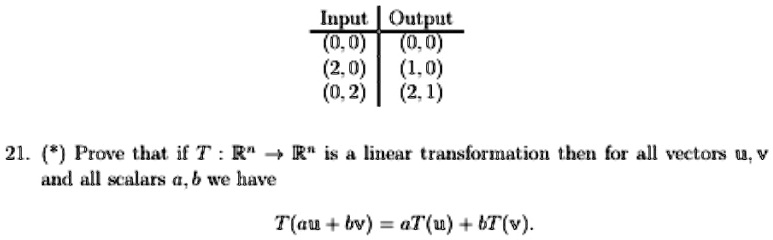
Input Output (0,0) (0,0) (2,0) (1,0) (0,2) (2,1) 21. (*) Prove that if $T: \mathbb{R}^n \to \mathbb{R}^n$ is a linear transformation then for all vectors $u$, $v$ and all scalars $a$, $b$ we have $T(au+bv) = aT(u) + bT(v)$.
10. Pear Inc. has a Beta (\(\beta\)) of 1.30. Assume the market return is 10.40% and the risk-free rate is 3.50%. Calculate the expected return on stock for Pear Inc.
Find the activation energy of gas oil cracking reaction for the following cases: (1) It cracks at 450°C 2 times rapidly as at 425°C. 2. It cracks at 475°C 4 times rapidly as at 425°C. 3. It cracks at 500°C 7 times rapidly as at 425°C. 4. It cracks at 525°C 11 times rapidly as at 425°C. 5. It cracks at 550°C 16 times rapidly as at 425°C. 6. It cracks at 575°C 25 times rapidly as at 425°C.