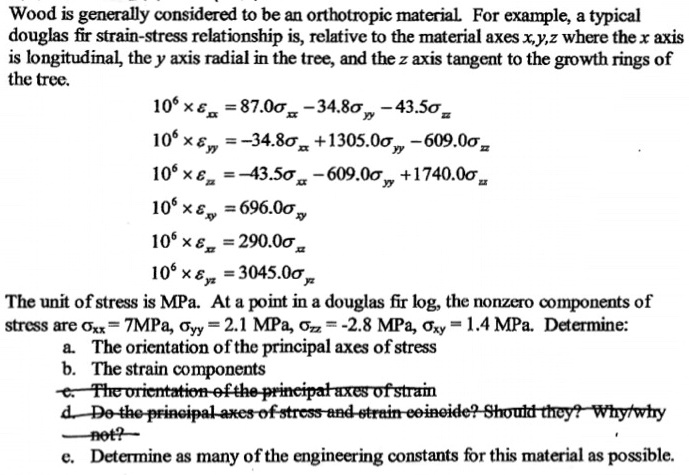
Wood is generally considered to be an orthotropic material. For example, a typical
douglas fir strain-stress relationship is, relative to the material axes x, y, z where the x axis
is longitudinal, the y axis radial in the tree, and the z axis tangent to the growth rings of
the tree.
$10^6 \times \epsilon_x = 87.0 \sigma_x - 34.8 \sigma_y - 43.5 \sigma_z$
$10^6 \times \epsilon_y = -34.8 \sigma_x + 1305.0 \sigma_y - 609.0 \sigma_z$
$10^6 \times \epsilon_z = -43.5 \sigma_x - 609.0 \sigma_y + 1740.0 \sigma_z$
$10^6 \times \epsilon_{xy} = 696.0 \sigma_{xy}$
$10^6 \times \epsilon_{xz} = 290.0 \sigma_{xz}$
$10^6 \times \epsilon_{yz} = 3045.0 \sigma_{yz}$
The unit of stress is MPa. At a point in a douglas fir log, the nonzero components of
stress are $\sigma_{xx} = 7 MPa$, $\sigma_{yy} = 2.1 MPa$, $\sigma_{zz} = -2.8 MPa$, $\sigma_{xy} = 1.4 MPa$. Determine:
a. The orientation of the principal axes of stress
b. The strain components
c. The orientation of the principal axes of strain
d. Do the principal axes of stress and strain coincide? Should they? Why/why
not?
e. Determine as many of the engineering constants for this material as possible.