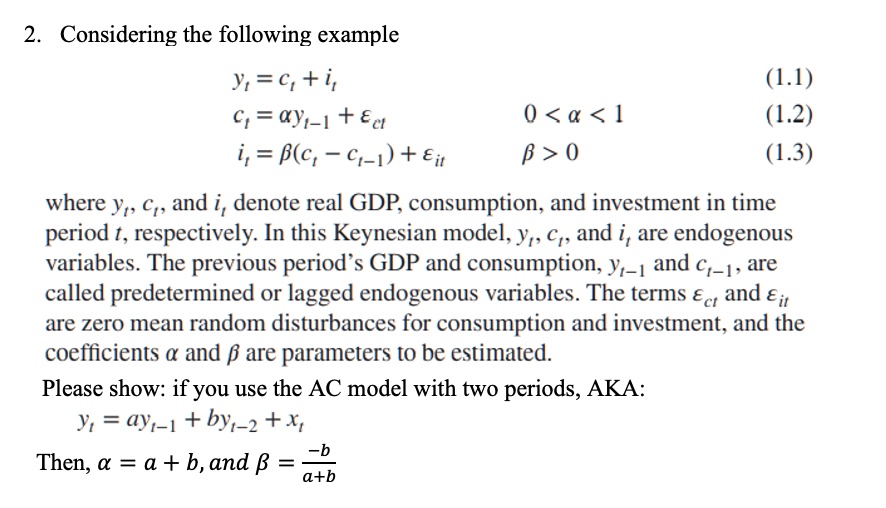
2. Considering the following example
$y_t = c_t + i_t$,
(1.1)
$c_t = \alpha y_{t-1} + \epsilon_{ct}$
$0 < \alpha < 1$
(1.2)
$i_t = \beta (c_t - c_{t-1}) + \epsilon_{it}$
$\beta > 0$
(1.3)
where $y_t$, $c_t$, and $i_t$ denote real GDP, consumption, and investment in time
period $t$, respectively. In this Keynesian model, $y_t$, $c_t$, and $i_t$ are endogenous
variables. The previous period's GDP and consumption, $y_{t-1}$ and $c_{t-1}$, are
called predetermined or lagged endogenous variables. The terms $\epsilon_{ct}$ and $\epsilon_{it}$
are zero mean random disturbances for consumption and investment, and the
coefficients $\alpha$ and $\beta$ are parameters to be estimated.
Please show: if you use the AC model with two periods, AKA:
$y_t = \alpha y_{t-1} + \beta y_{t-2} + x_t$
$-\beta$
Then, $\alpha = a + b$, and $\beta = \frac{-b}{a+b}$