Problem 3
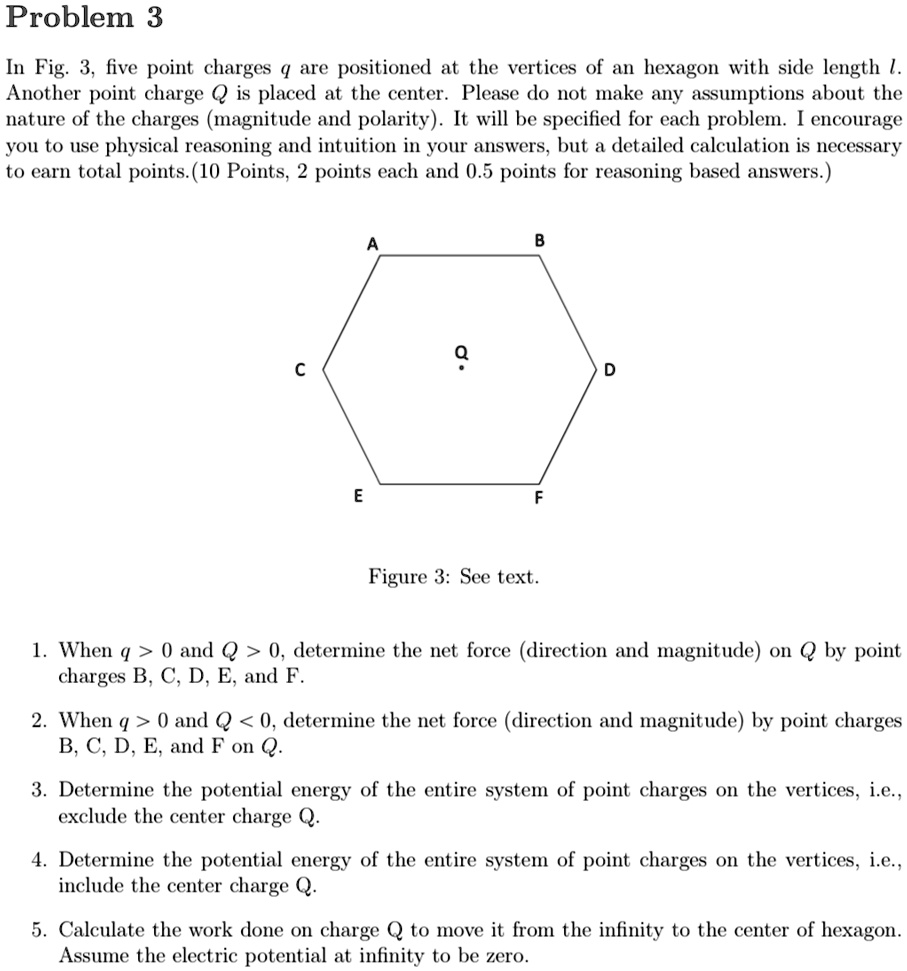
In Fig. 3, five point charges $q$ are positioned at the vertices of an hexagon with side length $l$.
Another point charge $Q$ is placed at the center. Please do not make any assumptions about the
nature of the charges (magnitude and polarity). It will be specified for each problem. I encourage
you to use physical reasoning and intuition in your answers, but a detailed calculation is necessary
to earn total points. (10 Points, 2 points each and 0.5 points for reasoning based answers.)
A
B
Q
C
D
E
F
Figure 3: See text.
1. When $q > 0$ and $Q > 0$, determine the net force (direction and magnitude) on $Q$ by point
charges B, C, D, E, and F.
2. When $q > 0$ and $Q < 0$, determine the net force (direction and magnitude) by point charges
B, C, D, E, and F on $Q$.
3. Determine the potential energy of the entire system of point charges on the vertices, i.e.,
exclude the center charge $Q$.
4. Determine the potential energy of the entire system of point charges on the vertices, i.e.,
include the center charge $Q$.
5. Calculate the work done on charge $Q$ to move it from the infinity to the center of hexagon.
Assume the electric potential at infinity to be zero.