Question 1) (10 points) As in the class slides, let's start with a standard production function of the form
$Y = Af(L, K)$,
where Y is output, L is input of labor, K is input of capital, and A is a parameter that changes over time
as technology changes (allowing output to expand without additional inputs). Totally differentiating the
equation above, re-arranging, and defining value shares for labor and capital in cost, we get
$\frac{\dot{A}}{A} = \frac{\dot{Y}}{Y} - s_L \frac{\dot{L}}{L} - s_K \frac{\dot{K}}{K}$.
Here, $s_i$ is the value share of factor $i$ in cost: $s_L = p_L L/(p_L L + p_K K)$ and $s_K = p_K K/(p_L L + p_K K)$, where
$p_L$ is price of labor and $p_K$ is price of capital.
This equation states that the rate of change of A ($\frac{\dot{A}}{A}$) is equal to the rate of change in output less the rate
of change of inputs, weighted by their relative importance (defined by cost shares). It defines what is known
as multifactor or total factor productivity (TFP) growth, because it recognizes changes in both output and
all of the input factors.
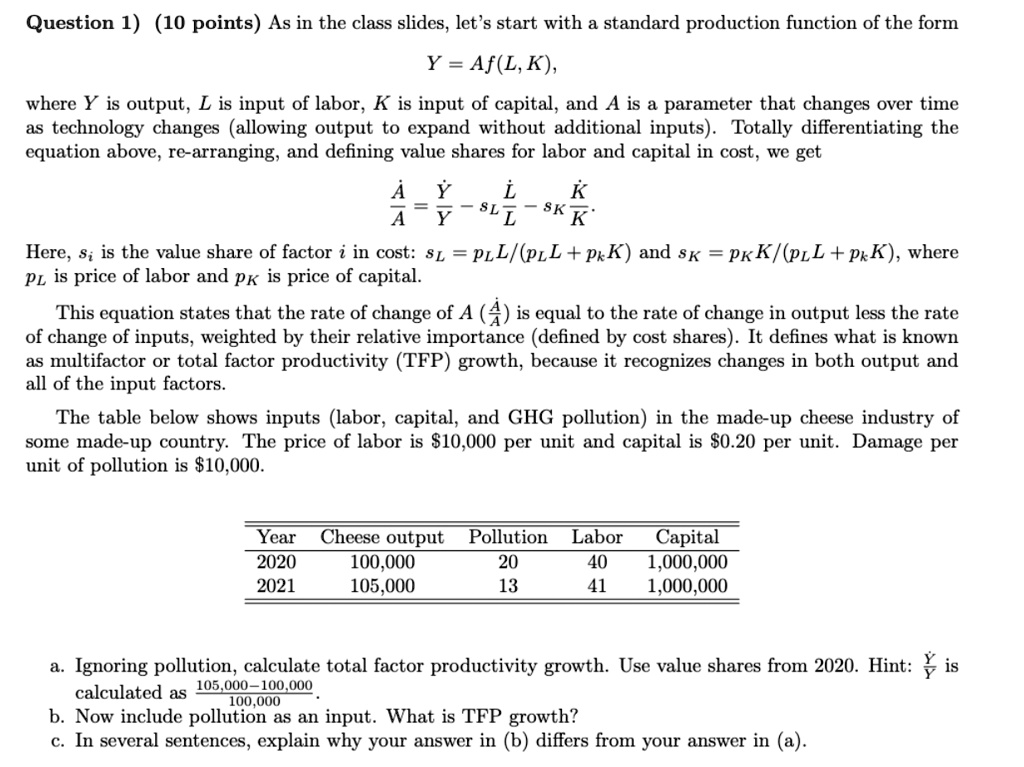
The table below shows inputs (labor, capital, and GHG pollution) in the made-up cheese industry of
some made-up country. The price of labor is $10,000 per unit and capital is $0.20 per unit. Damage per
unit of pollution is $10,000.
Year Cheese output Pollution Labor Capital
2020 100,000 20 40 1,000,000
2021 105,000 13 41 1,000,000
a. Ignoring pollution, calculate total factor productivity growth. Use value shares from 2020. Hint: $\frac{\dot{Y}}{Y}$ is
calculated as $\frac{105,000 - 100,000}{100,000}$.
b. Now include pollution as an input. What is TFP growth?
c. In several sentences, explain why your answer in (b) differs from your answer in (a).