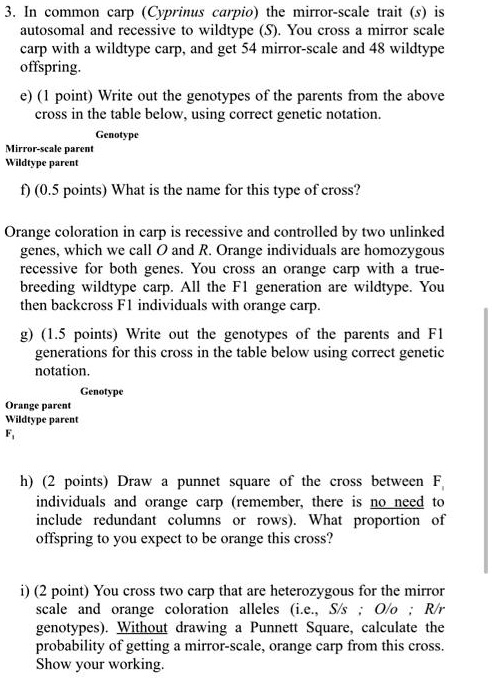
In common carp, Cyprinus carpio, the mirror-scale trait (s) is autosomal and recessive to wildtype (S). You cross a mirror scale carp with a wildtype carp and get 54 mirror-scale and 48 wildtype offspring.
e) Write out the genotypes of the parents from the above cross in the table below, using correct genetic notation.
Genotype Mirror-scale parent Wildtype parent
Ss SS
f) What is the name for this type of cross?
This type of cross is called a monohybrid cross.
Orange coloration in carp is recessive and controlled by two unlinked genes, which we call O and R. Orange individuals are homozygous recessive for both genes. You cross an orange carp with a true-breeding wildtype carp. All the F1 generation are wildtype. You then backcross F1 individuals with orange carp.
g) Write out the genotypes of the parents and F1 generations for this cross in the table below using correct genetic notation.
Genotype Orange parent Wildtype parent F1
oo OR OR
h) Draw a Punnett square of the cross between F1 individuals and orange carp. Remember, there is no need to include redundant columns or rows. What proportion of offspring do you expect to be orange in this cross?
Punnett square:
| Oo | Oo |
|--------|--------|
| OR | OR |
The proportion of offspring expected to be orange in this cross is 50%.
i) You cross two carp that are heterozygous for the mirror scale and orange coloration alleles, i.e. S/sO/oR/r genotypes. Without drawing a Punnett Square, calculate the probability of getting a mirror-scale, orange carp from this cross. Show your working.
Probability of getting a mirror-scale carp: 1/2 (from the S/s genotype)
Probability of getting an orange carp: 1/4 (from the O/o genotype)
Probability of getting a mirror-scale, orange carp: 1/2 * 1/4 = 1/8