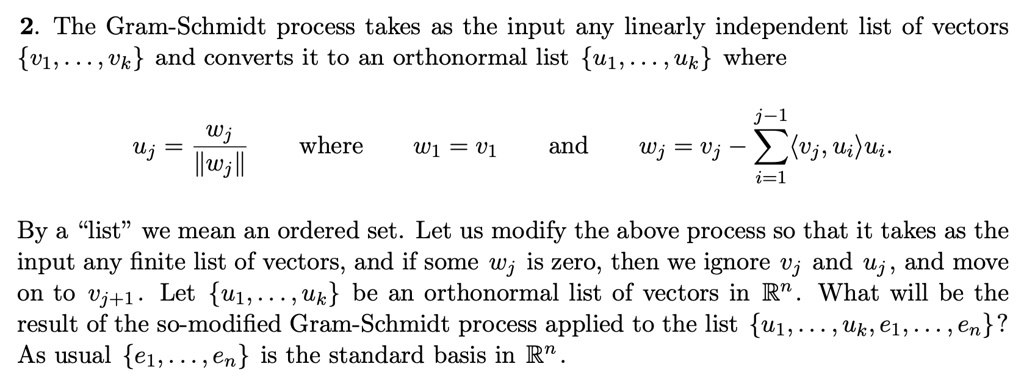
The Gram-Schmidt process takes as the input any linearly independent list of vectors {v1,...,vk} and converts it to an orthonormal list {u1,...,uk} where
||wj|| = 1
where
w1 = v1
and
wj = vj - (vj,ui)ui for i = 1
By a "list" we mean an ordered set. Let us modify the above process so that it takes as the input any finite list of vectors, and if some wi is zero, then we ignore ui and move on to Ui+1. Let {u1,...,uk} be an orthonormal list of vectors in R. What will be the result of the so-modified Gram-Schmidt process applied to the list {u1,...,uk,e1,...,en}? As usual {e1,...,en} is the standard basis in Rn.