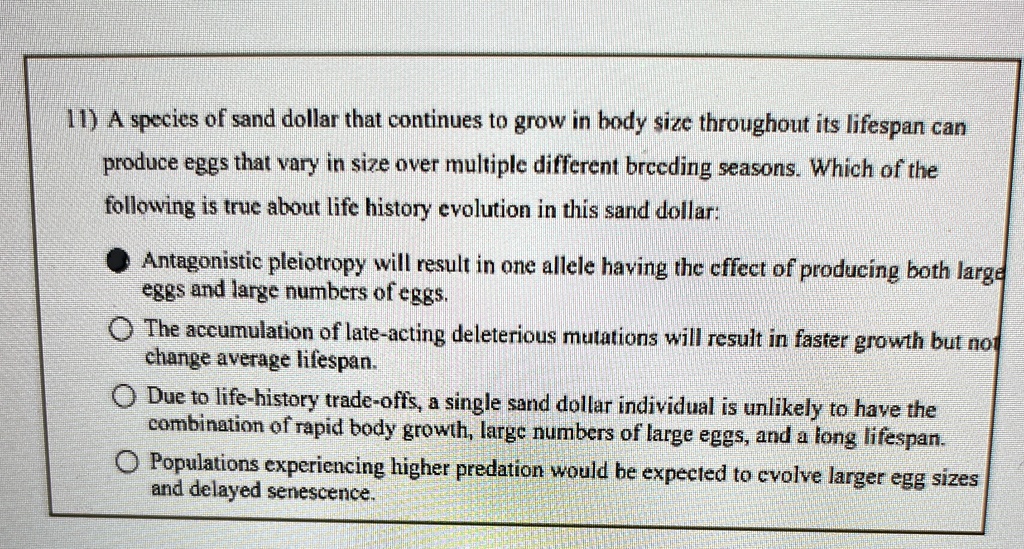
11) A species of sand dollar that continues to grow in body size throughout its lifespan can
produce eggs that vary in size over multiple different breeding seasons. Which of the following is true about life history evolution in this sand dollar:
Antagonistic pleiotropy will result in one allele having the effect of producing both large
eggs and large numbers of eggs.
The accumulation of late-acting deleterious mutations will result in faster growth but not
change average lifespan.
Due to life-history trade-offs, a single sand dollar individual is unlikely to have the
combination of rapid body growth, large numbers of large eggs, and a long lifespan.
Populations experiencing higher predation would be expected to evolve larger egg sizes
and delayed senescence.