14. [0/0.2 Points]
DETAILS
PREVIOUS ANSWERS
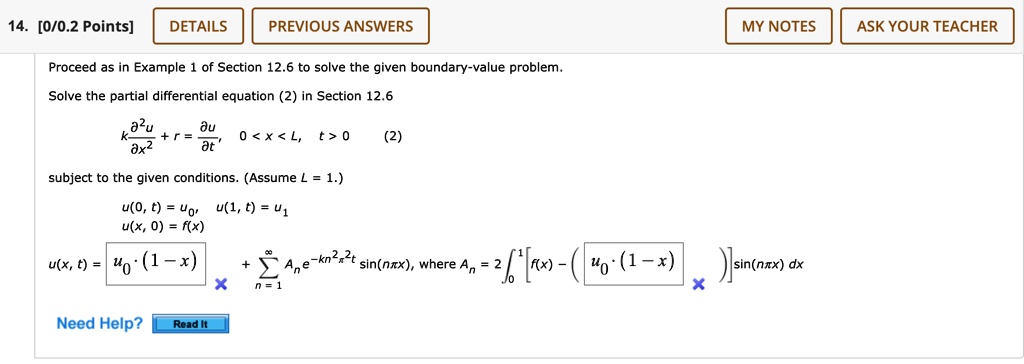
Proceed as in Example 1 of Section 12.6 to solve the given boundary-value problem.
Solve the partial differential equation (2) in Section 12.6
\begin{equation} k \frac{\partial^2 u}{\partial x^2} + r = \frac{\partial u}{\partial t}, \quad 0 < x < L, \quad t > 0 \end{equation} (2)
subject to the given conditions. (Assume $L = 1.$)
$u(0, t) = u_0$, $u(1, t) = u_1$
$u(x, 0) = f(x)$
$u(x, t) = u_0 (1 - x) + \sum_{n = 1}^{\infty} A_n e^{-k n^2 \pi^2 t} \sin(n \pi x)$, where $A_n = 2 \int_0^1 \left[ f(x) - \left( u_0 (1 - x) \right) \right] \sin(n \pi x) \, dx$