Ace - AI Tutor
Ask Our Educators
Textbooks
My Library
Flashcards
Scribe - AI Notes
Notes & Exams
Download App
Gui G

Gui G.

Divider

Viewed Questions

In Example 1.5, show that $a_{i}^{*}$ minimizes (1.6) for $i=0,1$, and simplify the expression for $a_{0}^{*}$. [Hint: $\Sigma \kappa p^{\kappa-1}$ and $\Sigma \kappa(\kappa-1) p^{\kappa-2}$ are the first and second derivatives of $\Sigma p^{k}=$ $1 / q$.]

Theory of Point Estimation

Unbiasedness

UMVU Estimators

Show that if $X_{1}, X_{2}, \ldots, X_{n}$ are mutually independent random variables, then $E\left(\prod_{i=1}^{n} X_{i}\right)=\prod_{i=1}^{n} E\left(X_{i}\right)$.

Show that if $X_{1}, X_{2}, \ldots, X_{n}$ are mutually independent random variables, then $E\left(\prod_{i=1}^{n} X_{i}\right)=\prod_{i=1}^{n} E\left(X_{i}\right)$.

Discrete Mathematics and its Applications

Discrete Probability

Expected Value and Variance

Let $f(x)=\frac{1}{3},-1<x<2$, zero elsewhere, be the pdf of $X$. Find the cdf and the pdf of $Y=X^{2}$. Hint: Consider $P\left(X^{2} \leq y\right)$ for two cases: $0 \leq y<\mathbb{1}$ and $1 \leq y<4$.

Let $f(x)=\frac{1}{3},-1<x<2$, zero elsewhere, be the pdf of $X$. Find the cdf and the pdf of $Y=X^{2}$. Hint: Consider $P\left(X^{2} \leq y\right)$ for two cases: $0 \leq y<\mathbb{1}$ and $1 \leq y<4$.

Introduction to Mathematical Statistics

Probability and Distributions

Continuous Random Variables

Let $X_{1}, X_{2}$, and $X_{3}$ be iid random variables, each with pdf $f(x)=e^{-x}$, $0<x<\infty$, zero elsewhere.
(a) Find the distribution of $Y=\operatorname{minimum}\left(X_{1}, X_{2}, X_{3}\right)$. Hint: $\quad P(Y \leq y)=1-P(Y>y)=1-P\left(X_{i}>y, i=1,2,3\right)$.
(b) Find the distribution of $Y=\operatorname{maximum}\left(X_{1}, X_{2}, X_{3}\right)$.

Let $X_{1}, X_{2}$, and $X_{3}$ be iid random variables, each with pdf $f(x)=e^{-x}$, $0<x<\infty$, zero elsewhere. (a) Find the distribution of $Y=\operatorname{minimum}\left(X_{1}, X_{2}, X_{3}\right)$. Hint: $\quad P(Y \leq y)=1-P(Y>y)=1-P\left(X_{i}>y, i=1,2,3\right)$. (b) Find the distribution of $Y=\operatorname{maximum}\left(X_{1}, X_{2}, X_{3}\right)$.

Introduction to Mathematical Statistics

Some Special Distributions

The $\Gamma, \chi^{2}$, and $\beta$…

Questions asked

ANSWERED

Aishwarya Krishnakumar verified

Numerade educator

Given ( A=left{(X, Y) in R^{2}: X geq 0, Y geq 0, X+Y leq 1 ight} ), let ( (X, Y) ) be a random point uniformly chosen from ( A ). Define ( Q ) as the quadrilateral with vertices ( (0,0),(X, Y),(X, 1) ), and ( (0,1) ). Calculate ( operatorname{Var}(W) ), where ( W ) represents the area of ( Q ).

View Answer
divider
ANSWERED

Rachel Gore verified

Numerade educator

30. Let ( (mathrm{X}, mathrm{Y}) ) be a discrete random vector with probability function given by [ P(X=x, Y=y)=frac{lambda^{y} e^{-2 lambda}}{x !(y-x) !} I_{{0, ldots, y}}(x) I_{N}(y), quad lambda>0 ] where ( N:={0,1,2, ldots} ) and ( I_{C}(x) ) denotes the indicator function of the set ( C: ) if ( x in C ), then ( I_{C}(x)=1 ), and ( I_{C}(x)=0 ) otherwise. (a) Calculate ( P(X=Y) ). (b) Obtain the conditional distribution of ( mathrm{X} ) given ( mathrm{Y}=mathrm{y} ), where ( y in N ). Are ( mathrm{X} ) and ( mathrm{Y} ) independent? Why?

View Answer
divider
ANSWERED

Hoan Nguyen verified

Numerade educator

Consider a point ( (X, Y) ) chosen uniformly from the set ( A=(X, Y) in R^{2}: X geq 0, Y geq 0, X+Y leq 1 ). (a) Determine ( P(Y>2 X) ). (b) Let ( W ) be the area of the quadrilateral with vertices ( (0,0),(X, 0),(X, 1) ), and ( (0,1) ). Calculate the expectation of ( W ).

View Answer
divider
ANSWERED

Hoan Nguyen verified

Numerade educator

Let (S, F, P) be a probability space. Let A1,..., An be events such that P(Ai) > 0 for i = 1,...,n. Show that: P(A1) = P(A2) = .... = P(An) = 1 <=> ?(k=i to n) Ak = 1.

View Answer
divider
INSTANT ANSWER

Suppose that \( \mathrm{X} \), given \( \mathrm{Y}=\mathrm{y} \), is distributed according to the binomial model with parameters y and \( 1 / 2 \). Determine: (a) the probability of the event \( X=1 \). (b) the conditional distribution of \( \mathrm{Y} \) given \( \mathrm{X}=1 \). (c) the expectation of \( \mathrm{X} \).

View Answer
divider
ANSWERED

Hoan Nguyen verified

Numerade educator

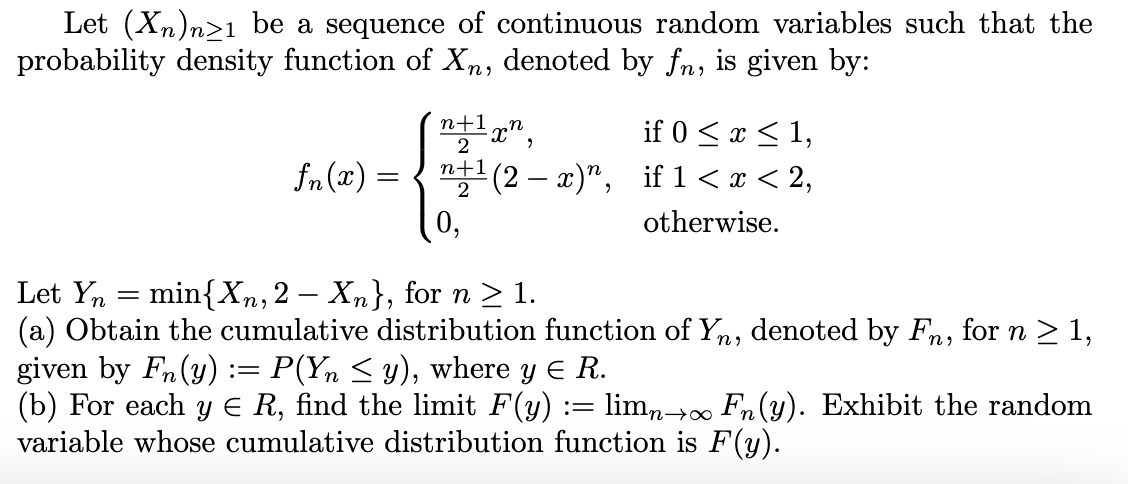
Let (X_n)_{n ? 1} be a sequence of continuous random variables such that the probability density function of X_n, denoted by f_n, is given by: f_n(x) = egin{cases} frac{n+1}{2} x^n, & ext{if } 0 le x le 1, \ frac{n+1}{2}(2-x)^n, & ext{if } 1 < x < 2, \ 0, & ext{otherwise.} end{cases} Let Y_n = min{X_n, 2 - X_n}, for n ? 1. (a) Obtain the cumulative distribution function of Y_n, denoted by F_n, for n ? 1, given by F_n(y) := P(Y_n ? y), where y ? R. (b) For each y ? R, find the limit F(y) := lim_{n ? ?} F_n(y). Exhibit the random variable whose cumulative distribution function is F(y).
View Answer
divider
ANSWERED

Hoan Nguyen verified

Numerade educator

Three points are randomly chosen in the interval ( [0,1] ). Let ( X_{i} ) be the i-th chosen point, ( mathrm{i}=1,2,3 ). (a) What is the probability that the third point falls between the other two? (b) Show that the cumulative distribution function of ( D=left|X_{1}-X_{2} ight| ) is given by: [ F(d)=left{egin{array}{ll} 0, & ext { for } d<0 \ 1-(1-d)^{2}, & ext { for } 0 leq d<1 \ 1, & ext { for } d geq 1 end{array} ight. ] (c) Find the mean and variance of ( D ).

View Answer
divider
ANSWERED

Lien Le verified

Numerade educator

An insurance company has 104 clients. Each client pays an annual premium of 12 monetary units (u.m.). The probability of a client experiencing a claim in one year is 6 * 10^(-3). The insurance company pays out 103 u.m. to the client in case of a claim. (a) Let X be the number of claims in one year. What is the distribution of X? (b) Using a normal approximation, calculate the probability that the insurance company's profit exceeds 4 * 10^4 u.m. in one year.

View Answer
divider
ANSWERED

Kirsty Gledhill verified

Numerade educator

Let Y be a random variable distributed according to the Poisson model with parameter ?, ? > 0. Suppose further that X, given Y = y, has a geometric distribution with parameter 1/(1+y). (Note: a variable ? has a geometric distribution with parameter p if P(? = n) = (1 - p)^{n-1}p, n = 1, 2, ...). Determine: (a) the probability of the event X = 1; (b) the conditional distribution of Y given X = 1; (c) the expectation of X.

View Answer
divider
INSTANT ANSWER

For each \( n \in N=\{1,2, \ldots\} \), let \( X_{n} \) be a random variable with probability distribution given by \[ P\left(X_{n}=j\right)=\frac{2 j}{n(n+1)}, \quad j=1, \ldots, n . \] Obtain: (a) the cumulative distribution function of the random variable \( Y_{n}=\frac{X_{n}}{n} \); (b) the limit, in distribution, of the sequence \( \left(Y_{n}\right)_{n \geq 1} \).

View Answer
divider