Ace - AI Tutor
Ask Our Educators
Textbooks
My Library
Flashcards
Scribe - AI Notes
Notes & Exams
Download App
iker cervantes

iker c.

Divider

Questions asked

BEST MATCH

consider a function f with lim x->a f(x) = -infinity what is lim x->a (-f(x))

View Answer
divider
BEST MATCH

The term dNTPs is short for all but a. dATP. b. dTTP. c. dGDP. d. dCTP Question 74 options: dATP dUTP dCTP dGDP

View Answer
divider
BEST MATCH

Consider the following DNA fragment from four different suspects in a crime: Suspect 1 - ACGTACGGTCCGACCTT Suspect 2 - ACCTACGGCGGCGGTCCGACCTT Suspect 3 - ACATACGGTCCGACCTT Suspect 4 - ACGTACGGCGGTCCGACCTT Select all of the true statements about these suspects and their DNA. Check All That Apply This stretch of DNA contains one SNP. This stretch of DNA contains two SNPs. Suspect 2 has three copies of an SNP. Suspects 1 and 3 have the same number of copies of an STR.

View Answer
divider
BEST MATCH

Which statement below is accurate with regard to the phenomenon of counter transference

View Answer
divider
BEST MATCH

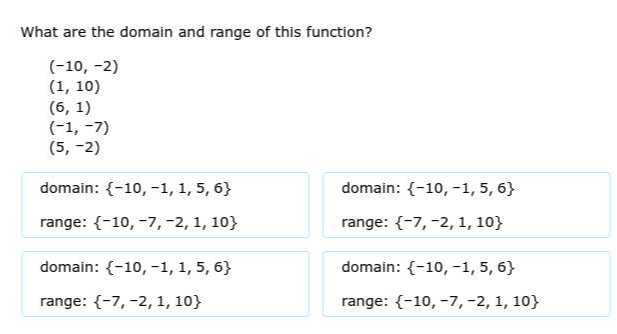
What are the domain and range of this function? \[ \begin{array}{l} (-10,-2) \\ (1,10) \\ (6,1) \\ (-1,-7) \\ (5,-2) \end{array} \] domain: \( \{-10,-1,1,5,6\} \) domain: \( \{-10,-1,5,6\} \) range: \( \{-10,-7,-2,1,10\} \) range: \( \{-7,-2,1,10\} \) domain: \( \{-10,-1,1,5,6\} \) domain: \( \{-10,-1,5,6\} \) range: \( \{-7,-2,1,10\} \) range: \( \{-10,-7,-2,1,10\} \)
View Answer
divider
BEST MATCH

Symptoms of disease differ from signs of disease in that symptoms ? are changes felt by the patient ? always occur as part of a syndrome ? are changes observed by the physician ? are specific for a particular disease Question 48

View Answer
divider
BEST MATCH

As edema decreases in a client with heart failure, what physiological response would the nurse expect to find? A. Increase in body weight. B. Rales across all lung fields. C. Respiratory rate greater than 24 breaths per minute. D. Increase in the urinary output.

View Answer
divider
BEST MATCH

Gas permeability coefficients of polymer films are typically measured by placing a film of uniform thickness in a permeation cell, which allows one side of the film (the so-called upstream side) to be exposed to a desired gas pressure, and the other side of the film (the downstream side) is connected to a rigid (e.g., stainless steel) container of known volume. Initially, the volume connected to the downstream side of the film is under vacuum. The pressure difference across the film drives permeation of gas from the upstream side of the film through the film and into the downstream volume. The downstream pressure is monitored as a function of time, and once the measurement comes to pseudo-steady state, the rate of pressure rise in the downstream volume is constant (i.e., independent of time). The entire system is kept at constant temperature. Knowing the rate of pressure rise in a container of fixed volume and temperature, as well as the cross-sectional area of the film, one can use the ideal gas law to calculate the gas flux through the film. Permeability, P, is defined as: \frac{P \times (Flux)(thickness)}{P_{upstream} - P_{downstream}} The experiments are typically organized so that the upstream pressure is orders of magnitude higher than the downstream pressure, so $P_{downstream}$ in the equation above is negligible. A student is conducting a permeation experiment on a 23µm thick polysulfone film with pure oxygen. The upstream pressure is set to 10 atm of oxygen, and the downstream pressure is initially 0 atm (absolute). After a sufficient amount of time passes to achieve steady-state permeation of oxygen through the film, the student notes that the pseudo-steady state rate of pressure rise in the downstream volume is 5.16x10<sup>4</sup> torr/s. From this steady state pressure change, calculate the oxygen permeability of this sample in Barrer. The downstream volume of the system is 46.5 cm³. The system is maintained at 35°C. The sample area is 0.904 cm². Recall that 1 Barrer = 10<sup>-10</sup> \frac{cm^3 (STP) cm}{cm^2 s (cm Hg)}. A useful value for the gas constant, R, is 0.278 \frac{cm Hg cm^3}{cm^3 STP \times K}

View Answer
divider
BEST MATCH

Temperature °C Weight Percent Nickel 0 10 20 30 40 50 1800 1600 L 1400 1200 1000 660,452°C 800 639,9°C 600- 854°C (Al) Al3Ni 400 0 10 20 30 Al 1133°C Al3Ni2 60 70 1638°C 80 90 100 1455°C AlNi 1395 1385 Ni (y) Al3Ni5 60 ~700°C 40 50 Atomic Percent Nickel (7+7) (7) -AlNi3 70 80 90 100 Ni

View Answer
divider
BEST MATCH

5. Let $h$ be a function whose first derivative is $h'(x) = \int_8^x 5(\ln(-t^5 + 5))^8 dt$. For $8 < x < 15$, which of the following is true? $h$ is increasing and the graph of $h$ is concave up. $h$ is decreasing and the graph of $h$ is concave down. $h$ is increasing and the graph of $h$ is concave down. $h$ is decreasing and the graph of $h$ is concave up. $h$ is increasing, then decreasing on the interval $8 < x < 15$ and the graph of $h$ is concave up.

View Answer
divider