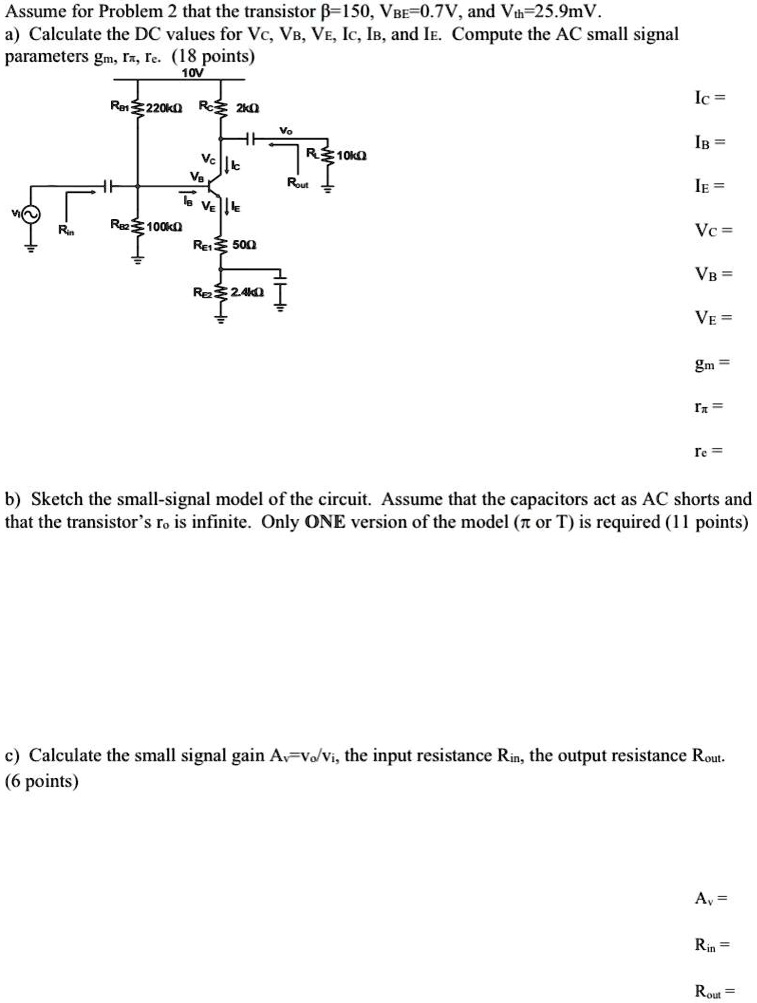
Assume for Problem 2 that the transistor \(\beta=150\), \(V_{BE}=0.7V\), and \(V_{th}=25.9mV\).
a) Calculate the DC values for \(V_C\), \(V_B\), \(V_E\), \(I_C\), \(I_B\), and \(I_E\). Compute the AC small signal
parameters \(g_m\), \(r_{\pi}\), \(r_e\). (18 points)
10V
\(R_{in}\) \(220k\Omega\) \(R_C\) \(2k\Omega\)
\(V_o\)
\(V_{CC}\)
\(V_C\)
\(R_L\) \(10k\Omega\)
\(V_B\)
\(R_{out}\)
\(I_C\)
\(V_{EE}\)
\(I_B\)
\(V_E\)
\(I_E\)
\(R_{in}\) \(100k\Omega\)
\(R_E\) \(500\Omega\)
\(R_E\) \(2.4k\Omega\)
\(I_C =\
\(I_B =\
\(I_E =\
\(V_C =\
\(V_B =\
\(V_E =\
\(g_m=\
\(r_{\pi}=\
\(r_e=\
b) Sketch the small-signal model of the circuit. Assume that the capacitors act as AC shorts and
that the transistor's \(r_o\) is infinite. Only ONE version of the model (\(\pi\) or T) is required (11 points)
c) Calculate the small signal gain \(A_v=v_o/v_i\), the input resistance \(R_{in}\), the output resistance \(R_{out}\).
(6 points)
\(A_v =\
\(R_{in} =\
\(R_{out} =\)