Ace - AI Tutor
Ask Our Educators
Textbooks
My Library
Flashcards
Scribe - AI Notes
Notes & Exams
Download App
ines meyer

ines m.

Divider

Questions asked

BEST MATCH

Postformal reasoning grows from the need to think logically in a world of relative choices. Question 13 options: TrueFalse

View Answer
divider
BEST MATCH

Which of the following technologies was developed or licensed by Apple but is not found on non-Apple products? USB Type C Mini-DisplayPort Thunderbolt Lightning

View Answer
divider
BEST MATCH

Problem 2. Assume that we use 2-level hashing where, at the second level, the hash table for a bucket with $s$ elements is exactly $s^2$. (a) Assume that $n = 2$ (so there are two items and the first level of the hash table has size 2), what is the expected size of the storage for the second level? (b) Assume that $n = 3$ (so there are three items and the first level of the hash table has size 3), what is the expected size of the storage for the second level?

View Answer
divider
BEST MATCH

Thinking Critically About: Do We Use Only 10 Percent of Our Brain? Electrically probing an association area won't trigger any observable response. So, unlike the somatosensory and motor areas, association area functions cannot be neatly mapped. Does this mean we don't use them? Thinking Critically About: Do We Use Only 10 Percent of Our Brain? LOQ 2-13 Is it true that 90 percent of our brain isn't really used? 1 Electrically probing an association area leads to no observable response. ? 2 This vast association area "silence" has led to the false claim that we really use only 10 percent of our brain- "one of the hardiest weeds in the garden of psychology." 1 3 Is there really a 90 percent chance that a bullet to your brain would land in an unused area? Brain-damaged animals and humans bear witness:

View Answer
divider
BEST MATCH

If you were told that the exchange rate was 1.2 Canadian dollars per U.S. dollar, a watch that costs $12 US dollars would cost $8.5 Canadian dollars. $10 Canadian dollars. $12.20 Canadian dollars. $14.40 Canadian dollars. Question 3 (1 point)

View Answer
divider
BEST MATCH

Using KVL, KCL, and Ohm's Law, analyze the circuit recording the following: I1 = I2 = I3 = IT - Add the values from Step 2 together: I1 + I2 + I3 = _______ A - Is the sum from Step 3 equal to IT evaluated in Step 2? _________ (YES or NO) Explain your answer. - Calculate the following voltages for this circuit: VR1 = VR2 = VR3 = - Add the values from Step 5 together: VR1 + VR2 + VR3 = _______ V - Is the sum from Step 6 equal to Vs? _________ (YES or NO) Explain your answer. Given the series and parallel circuit in Figure 5.1, calculate the total equivalent resistance RT of the circuit: RT = IT / (1/((1/R1) + (1/R4) + (1/R7)) + 1/((1/R2) + (1/R5) + (1/R6))) Vs = 10V R1 = 330 R2 = 390 R3 = 470 R4 = 330 R5 = 390 R6 = 470 R7 = 1.2k

View Answer
divider
BEST MATCH

A R-L circuit consists of one resistance 5.7 Ohm and one unknown Inductance. A voltage v=15 sin(326 t) is applied to this circuit and measured current is 0.3 A. Find out the unknown Inductance in mH unit. Hint: In R-L circuit, there is no C. So, calculate total impedance Z omitting the C term.

View Answer
divider
BEST MATCH

P6-22 (similar to) Yield to maturity The bond shown in the following table pays interest annually. (Click on the icon here in order to copy the conter spreadsheet.) Par value $1,000 Coupon interest rate Years to maturity Current value 11% 20 $1,570 a. Calculate the yield to maturity (YTM) for the bond. b. What relationship exists between the coupon interest rate and yield to maturity and the par value and market value of a bond? Explain. a. The yield to maturity (YTM) for the bond is %. (Round to two decimal places.)

View Answer
divider
BEST MATCH

Select the correct choice from the drop-down menu. The Select... is the skin layer that contains blood vessels, nervous tissue, hair follicles, and muscle tissue.

View Answer
divider
BEST MATCH

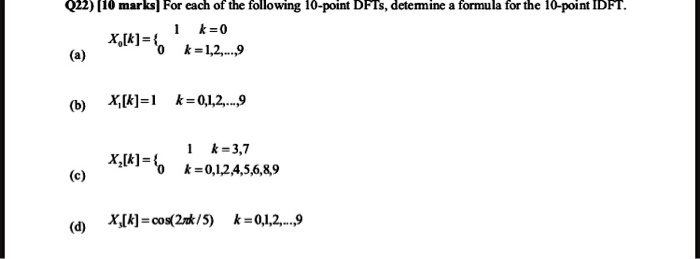
Q22) [10 marks] For each of the following 10-point DFTs, determine a formula for the 10-point IDFT. (a) $X_0[k] = \begin{cases} 1 & k = 0 \\ 0 & k = 1,2,...,9 \end{cases}$ (b) $X_1[k] = 1$ $k = 0,1,2,...,9$ (c) $X_2[k] = \begin{cases} 1 & k = 3,7 \\ 0 & k = 0,1,2,4,5,6,8,9 \end{cases}$ (d) $X_3[k] = \cos(2\pi k/5)$ $k = 0,1,2,...,9$
View Answer
divider