Ace - AI Tutor
Ask Our Educators
Textbooks
My Library
Flashcards
Scribe - AI Notes
Notes & Exams
Download App
ines trujillo

ines t.

Divider

Questions asked

BEST MATCH

Why are safety and risk two sides of the same coin

View Answer
divider
BEST MATCH

9.6. Let \( G \) be a group. Recall that \( G^{\prime}=[G, G] \) is the derived subgroup (or commutator subgroup) of \( G \), which is generated by all commutators \( [g, h]=g^{-1} h^{-1} g h \), where \( g, h \in G \). Show that (a) \( G^{\prime} \unlhd G \); (b) \( G / G^{\prime} \) is abelian; (c) \( G / N \) is abelian if and only if \( N \geq G^{\prime} \); (d) \( H^{\prime} \leq G^{\prime} \) if \( H \leq G \).

View Answer
divider
BEST MATCH

A car is traveling westward with a constant speed of 23.6 what is the resultant force acting on it?

View Answer
divider
BEST MATCH

at^2\n$x(t) = x_0 + v_0t + \frac{at^2}{2}$\nwhere:\n$\bullet$ $x_0$ represents the position at time 0.\n$\bullet$ $v_0$ represents the velocity at time 0.\n$\bullet$ a represents the acceleration.\nAssuming that:\n$\bullet$ all the required double variables t, $x_0$, $v_0$, and a have been declared and initialized to model all the different parameters;\n$\bullet$ a double variable x has been declared.\nWrite a statement that assigns the position at time t to the variable x.

View Answer
divider
BEST MATCH

ros and cons of a roadmap and a straight course of action

View Answer
divider
BEST MATCH

Part C A package of mass $m$ is placed onto a horizontal conveyor belt moving at speed $v$ (Figure 1). The coefficient of kinetic friction between package and belt is $\mu_k$. How much work is done by the conveyor belt's motor? Express your answer in terms of some or all of the variables $m$, $v$, $\mu_k$, and the acceleration due to gravity $g$. W =

View Answer
divider
BEST MATCH

How many Hâ‚‚O molecules can be formed by the reaction of the Hâ‚‚ and Oâ‚‚ in the picture? White: Hâ‚‚, Red: Oâ‚‚

View Answer
divider
BEST MATCH

Texts: Linear Algebra Thanks for the help. Exercise 1. An operator F on a Hermitian product space is called self-adjoint if it has an adjoint Ft and Ft = F. Consider the linear operator F := i, i.e. Ff = if, on the following complex vector V = C[ab], C V = {feV | fa = fb}, V = {fEV | fa = 0}, with Hermitian product f,9. 1. Show that F on V and on V3 is self-adjoint. 2. We now want to show that F on Vi is not self-adjoint because it does not have an adjoint. a) Assume by contradiction that Ft: V -> V exists. Let G = Ft - F. Show that Vg e V3 Gfg = 0. Hint: Observe first that Gfg = fFg - Ffg. b) Show that if h EV satisfies h9 = 0, Vg e V3, then h = 0. Hint: You may use the fact that for every o R and e > 0, it is possible to find an infinitely differentiable non-negative function g that is equal to 1 in the interval o - e < x < o + e and equal to 0 outside the interval x < o - 2e, x > o + 2e. See Figure 1 for an example. c) Conclude that G is the zero operator. d) Show on the other hand that there are fg EV such that Gfg ≠ 0. So G cannot be the zero operator.

View Answer
divider
BEST MATCH

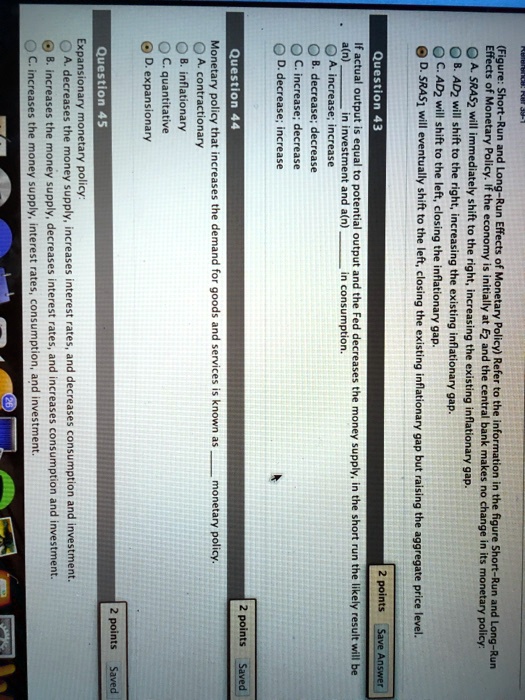
Re:39-1 (Figure: Short-Run and Long-Run Effects of Monetary Policy) Refer to the information in the figure Short-Run and Long-Run Effects of Monetary Policy. If the economy is initially at E2 and the central bank makes no change in its monetary policy: A. SRAS2 will immediately shift to the right, increasing the existing inflationary gap. B. AD2 will shift to the right, increasing the existing inflationary gap. C. AD2 will shift to the left, closing the inflationary gap. D. SRAS1 will eventually shift to the left, closing the existing inflationary gap but raising the aggregate price level. Question 43 2 points Save Answer If actual output is equal to potential output and the Fed decreases the money supply, in the short run the likely result will be a(n) ______ in investment and a(n) ______ in consumption. A. increase; increase B. decrease; decrease C. increase; decrease D. decrease; increase Question 44 Monetary policy that increases the demand for goods and services is known as ______ monetary policy. A. contractionary B. inflationary C. quantitative D. expansionary 2 points Saved Question 45 Expansionary monetary policy: A. decreases the money supply, increases interest rates, and decreases consumption and investment. B. increases the money supply, decreases interest rates, and increases consumption and investment. C. increases the money supply, interest rates, consumption, and investment. 26 2 points Saved
View Answer
divider
BEST MATCH

Consider the following function. f(6) = 16, f'(6) = 8.4; x = 6.5 (a) Write a linearization for f with respect to x. f_L(x) = (b) Use the linearization to estimate f at the given input. f_L(6.5) =

View Answer
divider