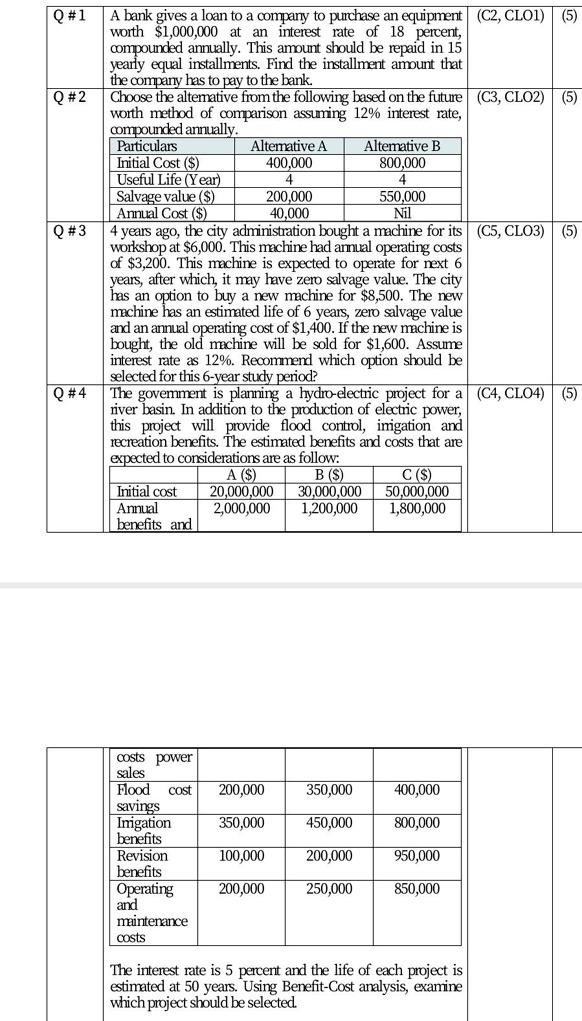
A bank gives a loan to a company to purchase an equipment C2, CLO1 (5) worth $1,000,000 at an interest rate of 18 percent, compounded annually. This amount should be repaid in 15 yearly equal installments. Find the installment amount that the company has to pay to the bank. Choose the alternative from the following based on the future C3, CLO2 (5) worth method of comparison assuming 12% interest rate, compounded annually.
Particulars Alternative A Alternative B
Initial Cost ($400,000) ($800,000)
Useful Life (Years) 4 4
Salvage value ($) $200,000 $550,000
Annual Cost ($) $40,000 Nil
4 years ago, the city administration bought a machine for its C5, CLO3 (5) workshop at $6,000. This machine had annual operating costs of $3,200. This machine is expected to operate for the next 6 years, after which, it may have zero salvage value. The city has an option to buy a new machine for $8,500. The new machine has an estimated life of 6 years, zero salvage value, and an annual operating cost of $1,400. If the new machine is bought, the old machine will be sold for $1,600. Assume the interest rate as 12%. Recommend which option should be selected for this 6-year study period?
The government is planning a hydro-electric project for a (C4, CLO4) (5) river basin. In addition to the production of electric power, this project will provide flood control, irrigation, and recreation benefits. The estimated benefits and costs that are expected to be considered are as follows:
A ($) B ($) C ($)
Initial cost 20,000,000 30,000,000 50,000,000
Annual benefits and costs
Power sales 200,000 350,000 400,000
Flood cost savings 350,000 450,000 800,000
Irrigation benefits 100,000 200,000 950,000
Recreation benefits 200,000 250,000 850,000
Operating and maintenance costs 200,000 250,000 850,000
The interest rate is 5 percent, and the life of each project is estimated at 50 years. Using Benefit-Cost analysis, examine which project should be selected.