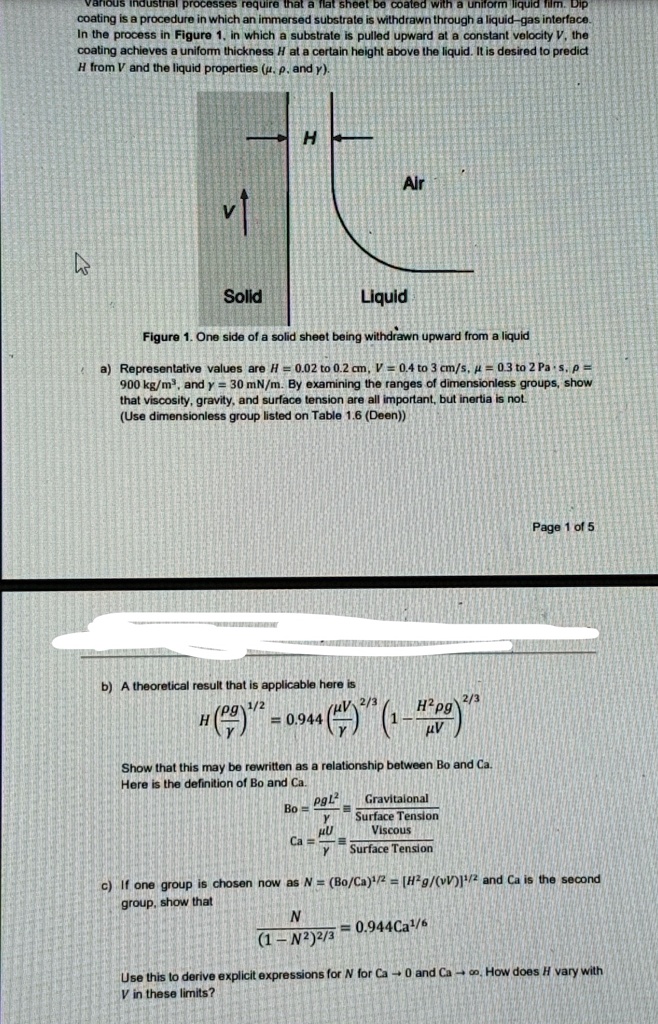
coating is a procedure in which an immersed substrate is withdrawn through a liquid-gas interface. In the process in Figure 1, in which a substrate is pulled upward at a constant velocity V, the coating achieves a uniform thickness H at a certain height above the liquid. It is desired to predict H from V and the liquid properties, and γ.
a) Representative values are H = 0.02 to 0.2 cm, V = 0.4 to 3 cm/s, μ = 0.3 to 2 Pa*s, ρ = 900 kg/m³, and γ = 30 mN/m. By examining the ranges of dimensionless groups, show that viscosity, gravity, and surface tension are all important, but inertia is not. (Use dimensionless group listed on Table 1.6 (Deen))
b) A theoretical result that is applicable here is:
H(ρg/γ)^(1/2) = 0.944(μV/γ)^(2/3)(1 - (H^2ρg)/(μV))^(2/3)
Show that this may be rewritten as a relationship between Bo and Ca. Here is the definition of Bo and Ca:
Bo = (ρgL^2)/γ = Gravitational/Surface Tension
Ca = (μU)/γ = Viscous/Surface Tension
c) If one group is chosen now as N = (Bo/(Ca))^1/2 = [H^2(g)/(vV)]^1/2 and Ca is the second group, show that:
(N)/(1-N^2)^(2/3) = 0.944Ca^(1/6)
Use this to derive explicit expressions for N for Ca -> 0 and Ca -> ∞. How does H vary with V in these limits?